
Short answer
A buffer tank is a buffer volume that temporarily stores water between the heat source and the installation in a heating system. It collects the heat produced by a heat pump or solid-fuel boiler and delivers it to the heating circuit in a balanced way. This prevents the heat source from switching on and off too frequently (short cycling), so the system runs more stably and efficiently. Because a buffer tank holds closed-loop heating water rather than domestic water, it needs no inner coating. For product details, see the buffer tank page.
What is a buffer tank?
A buffer tank buffers the water in a heating circuit, meaning it temporarily stores and balances it. The water inside is closed-loop heating water — the circuit water, often with additives, that feeds radiators, underfloor heating or fan coils. This water never reaches a tap.
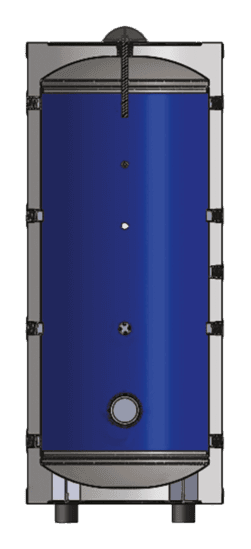
This is the key point that sets a buffer tank apart from an accumulation tank. An accumulation tank stores domestic hot water and therefore has an enamel inner coating and cathodic protection. A buffer tank, because it never contacts domestic water, needs no inner coating; it is built with a high-insulated but simpler body. Omega buffer tanks are made in 14 sizes from 50 to 5,000 liters.
What does a buffer tank do?
The core job of a buffer tank is to prevent the heat source from switching on and off too frequently (short cycling).
Heat sources such as heat pumps or solid-fuel boilers cut in and out constantly when heating demand is low. This behavior causes three problems: efficiency drops, equipment wears, and comfort fluctuates. A buffer tank breaks this cycle by adding a buffer volume to the system:
- Prevents short cycling: The heat source runs in longer, steadier cycles.
- Adds thermal inertia: It improves thermal stability, especially in low-water-content condensing boilers.
- Provides hydraulic separation: It lets the production side and the distribution side run at independent flow rates.
As a result, a buffer tank extends the heat source's life, improves energy efficiency and stabilizes the system.
How does a buffer tank work?
A buffer tank is connected between the production side (heat pump or boiler) and the distribution side (radiators, underfloor heating) of a heating system. It hydraulically separates the two circuits, so each side can run at its own flow rate and temperature independently.
The heat source transfers the heat it produces to the buffer tank, which stores it. When a heating demand arrives, the distribution side draws the heat it needs from the volume accumulated in the buffer tank rather than directly from the heat source. When demand drops, the heat source does not have to shut off immediately; it keeps running steadily, storing surplus heat in the tank.
Where is a buffer tank used?
A buffer tank is used in systems where the heat source's operating character does not match the heating demand:
- Heat pump systems: A buffer tank is usually a core component for a heat pump to run efficiently and stably. It is planned together with the heat pump water heater.
- Solid-fuel boiler systems: Stores heat across fuel-loading intervals for balanced distribution.
- Condensing boilers: Adds thermal inertia to modern boilers with a low internal water volume.
- Multi-zone heating: Lets zones with different temperatures and flow rates (radiator + underfloor) run in balance within one system.
Where each port goes in a heat pump installation is covered, with schematics, in our heat pump water heater diagram.
Buffer tank vs. accumulation tank
The two tanks are often confused but work in different circuits, doing different jobs:
- A buffer tank holds closed-loop heating water; its purpose is stable heat-source operation. It needs no inner coating.
- An accumulation tank holds domestic hot water; its purpose is to deliver hot-water flow at peak. Enamel coating and cathodic protection are essential.
We compared which facility needs which in detail in our accumulation tank vs. buffer tank article. For an overview of water heater and tank types, see our what is a water heater article.
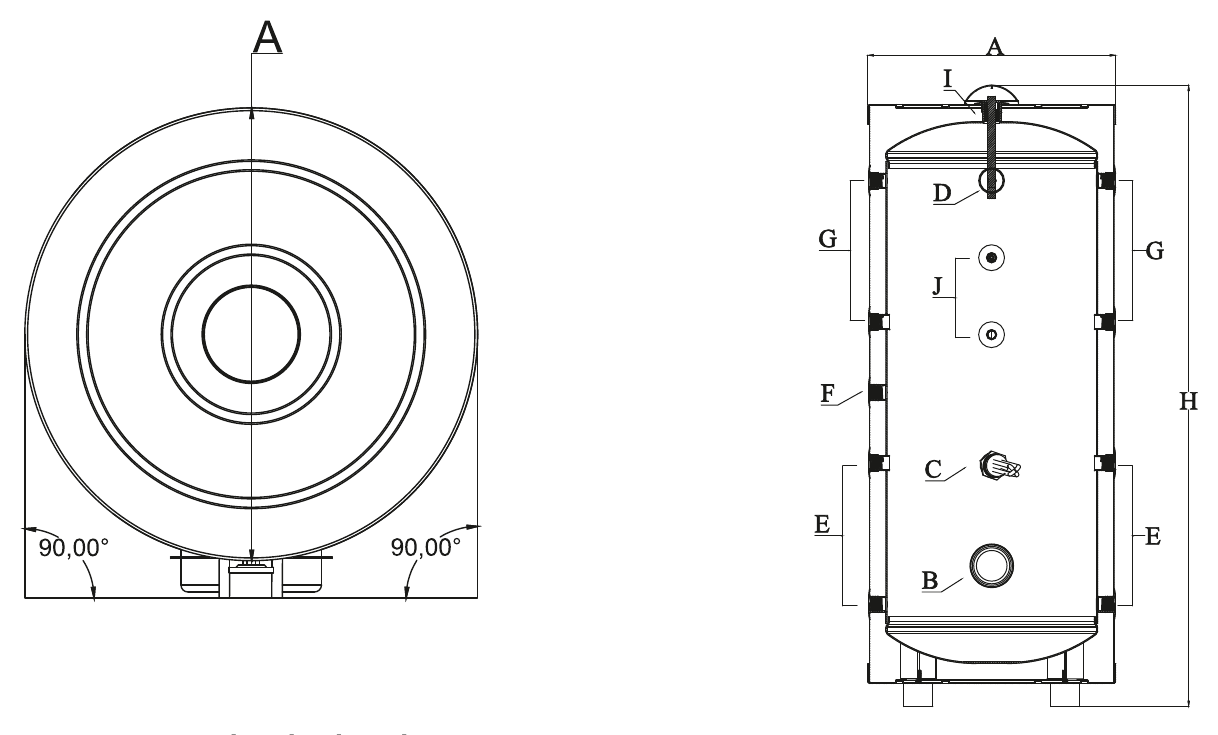 Technical dimension and connection diagram of a buffer tank
Frequently asked questions
What does a buffer tank do?
Especially in heat pump and solid-fuel boiler systems, a buffer tank prevents the heat source from switching on and off too frequently. This improves efficiency, extends equipment life, and delivers balanced distribution by storing surplus heat.
Is a buffer tank the same as an accumulation tank?
No. A buffer tank holds closed-loop heating water and needs no inner coating; its purpose is stable heat-source operation. An accumulation tank stores domestic hot water, has enamel coating and cathodic protection, and its purpose is to provide hot water at peak demand. For a detailed comparison, see our accumulation tank vs. buffer tank article.
How many liters of buffer tank are needed?
Buffer tank volume is set by the heat pump's output and the system's water volume. The general rule is about 10-15 liters of buffer volume per kW of heat pump output; for example, a 12 kW heat pump suits a 120-180 liter buffer tank. For the exact volume, get in touch with us.
To determine the buffer tank volume and setup that fit your system, get in touch with us or browse the full product family on the buffer tank page. Let's plan the right solution together.