
Short answer
A heating coil is a curved pipe that passes the heat of the fluid inside it to the medium around it. In a water heater the pipe sits inside the tank: hot water from the boiler runs through the pipe, the stored domestic water surrounds it, heat conducts through the pipe wall, and the two bodies of water never mix at any point. A heating coil is a heat exchanger buried in a tank. The figure people check when choosing a water heater is litres. What sets how fast the water heats, and how fast it recovers while being drawn off, is coil surface area. The 13 single coil water heater sizes in the Omega catalogue show it plainly: the 100 litre model carries 0.61 m² of coil surface per 100 litres, and on the 5,000 litre model the same measure falls to 0.19 m². Below: what a coil does, the types in use, and what that surface figure means at selection.
What does a heating coil do?
A heating coil looks like it has one job, moving heat. It produces three separate results.
It keeps two bodies of water apart. Boiler circuit water travels the whole pipework, may carry additives, and is not the water that comes out of the tap. In solar systems the collector circuit carries an antifreeze fluid; the coil is what stops it reaching the domestic water.
It passes heat into the water. The heating power of a water heater is only as high as the heat its coil can pass in a given time. However large the boiler, the result does not change if the coil is the bottleneck.
It combines heating and storage in one body. No separate exchanger, charging pump or controls outside the tank. The price is that the transfer surface is limited to what fits inside.
How a heating coil works
A coil has two sides. Inside the pipe runs the fluid giving heat up: boiler water, the flow from a heat pump, or the fluid returning from a solar collector. Outside it sits the water taking heat on, the stored domestic water.
Three things set the heat transferred: surface area, the temperature difference between the sides, and the heat conduction behaviour of the pipe material. The first and the third are fixed at manufacture; the temperature difference changes throughout operation. That is why the same water heater behaves differently with a different heat source.
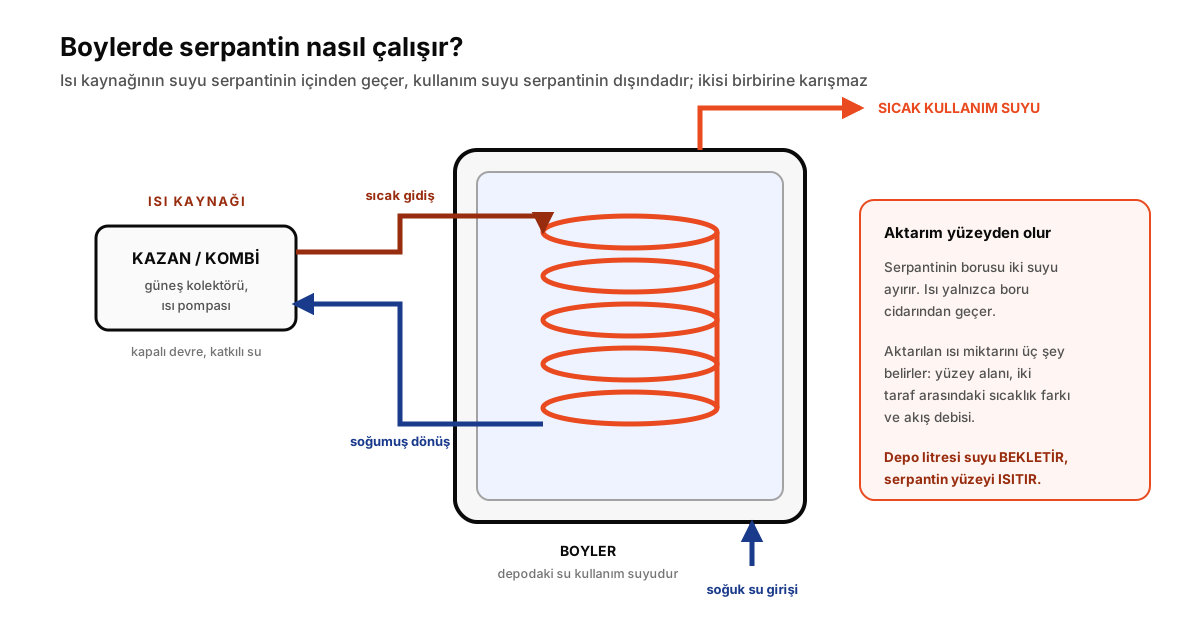 Cross-section of a coil water heater: hot water from the boiler passes through the helically wound coil and gives its heat up to the domestic water in the tank, the heated water rises to the upper part of the tank, the cold water sinks to the base, and the two circuits never join at any point
Why curved rather than straight? To fit as much surface as possible into a limited volume. A straight pipe would have to be many times the height of the tank for the same surface. A helical winding is how metres of pipe go inside one tank.
Where the coil sits matters too. Heated water rises, cooled water sinks to the base. With the coil in the lower region the heating water sets up its own circulation towards the top and the whole volume comes into play. An arrangement that heats only the upper region leaves the cold volume below it largely idle.
Types of heating coil
The word coil does not belong to water heaters alone. It is the general name for curved pipe bundles that pass heat from a fluid into another medium, and it turns up in very different places in an installation.
Water heater coil
The type used on the domestic hot water side, and the subject of this article. It sits inside the tank, flow line of the heat source on one end, return on the other. A body may hold one coil or two. The what is a water heater article covers the body as a whole; the water heater range lists the sizes produced, from 100 litres up to 5,000.
Air conditioning and cooling coil
In air handling units, fan coil units and chillers the coil works between water and air. Thin metal fins are fitted over the pipes and air passing between them is heated or cooled. On a cooling coil, water drips once the surface temperature falls below the dew point of the air, so a condensate tray sits underneath. Same logic, different medium.
Hairpin tube and electric element types
Two further arrangements get discussed under the same heading. The hairpin tube type is a bundle of straight tubes turning back in a U shape rather than a helix; some tank and boiler bodies prefer it. An electric immersion element is not technically a coil, because it takes heat from no other fluid; it converts electricity straight into heat. It can sit alongside the coil as a supplementary source, and its curved shape gets it confused with one.
Coil surface in a water heater: the figure that matters more than litres
The intuitive expectation is that the coil grows in step with the tank. The catalogue says otherwise.
| Capacity (L) | Coil surface (m²) | Surface per 100 L (m²) |
|---|---|---|
| 100 | 0.61 | 0.61 |
| 160 | 0.9 | 0.56 |
| 200 | 1.38 | 0.69 |
| 300 | 1.65 | 0.55 |
| 500 | 2.4 | 0.48 |
| 800 | 2.9 | 0.36 |
| 1000 | 3.5 | 0.35 |
| 1500 | 4.6 | 0.31 |
| 2000 | 5.1 | 0.25 |
| 2500 | 6.1 | 0.24 |
| 3000 | 6.5 | 0.22 |
| 4000 | 8.1 | 0.20 |
| 5000 | 9.4 | 0.19 |
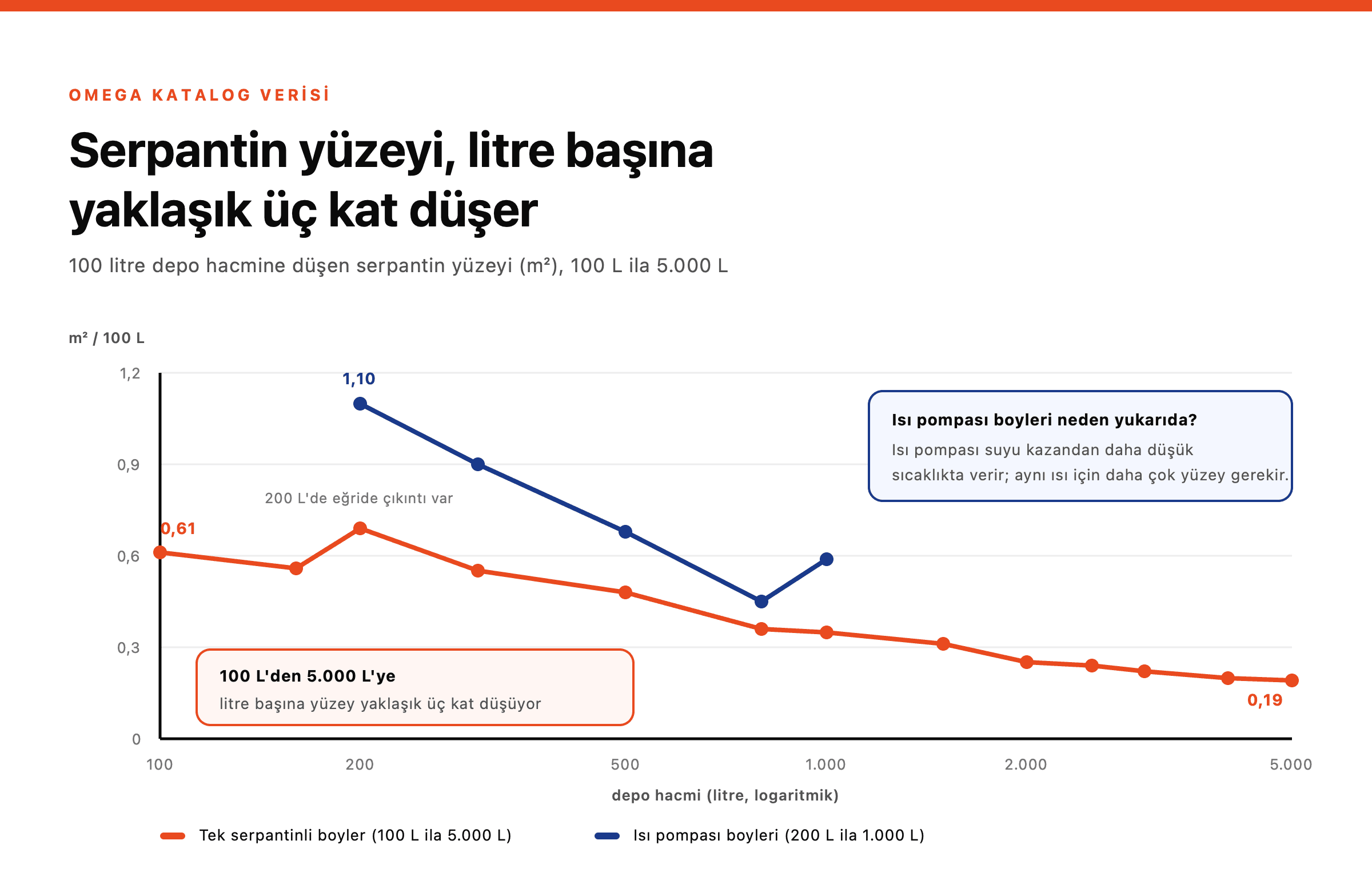
The right-hand column is not a smooth curve falling in one direction. At 0.69 m² the 200 litre water heater carries the highest value on the list, above even the 100 litre model, while at 160 litres the value drops to 0.56. That bump comes from body diameter and winding geometry being worked out again at every size. We leave the figures as they are rather than round them into a smooth curve. The direction is not in question: 0.61 m² per 100 L at the top end, 0.19 m² per 100 L at the bottom. Roughly three times.
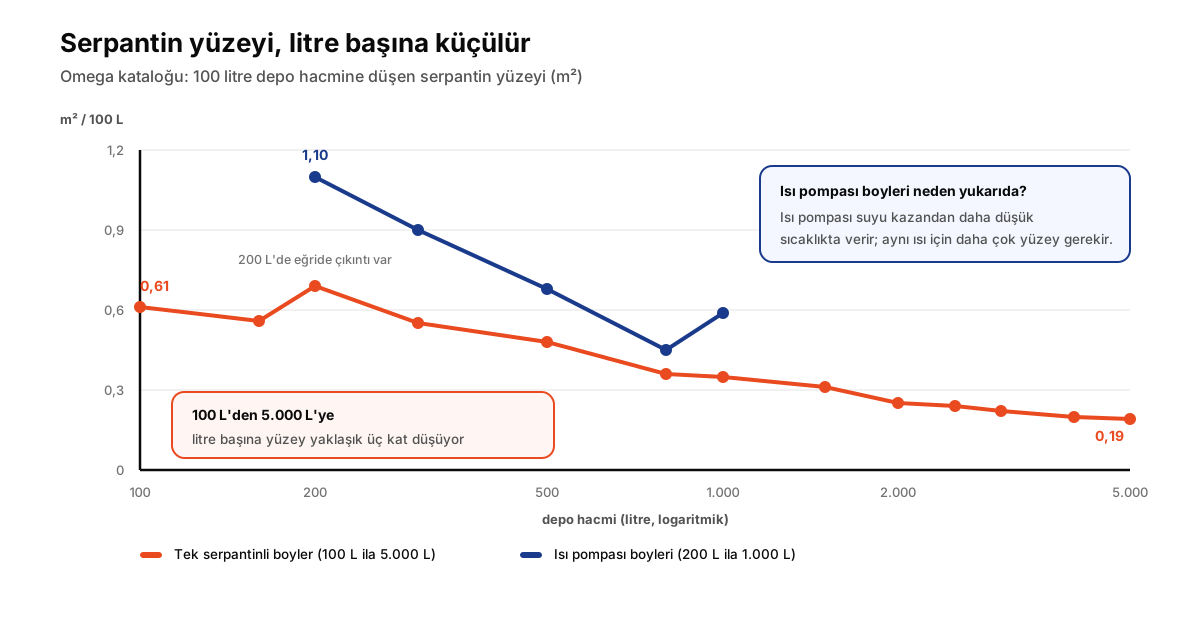 Chart of coil surface per 100 litres against volume in single coil Omega water heaters: the curve starts at 0.61 square metres at 100 litres, climbs to its peak of 0.69 square metres at 200 litres, then falls continuously to 0.35 at 1,000 litres and 0.19 square metres at 5,000 litres
As volume grows the heat transfer surface does not grow at the same rate. What a large tank buys is hot water standing ready at the moment of peak, not recovery speed. Short, sharp peak demand, say the morning shower hour in a hotel, and litres do the job. Demand flowing steadily through the day, say a laundry or a facility running shifts, and surface is the figure to check.
So water heater selection is two decisions, and they do not come out of the same number. Work out the litres with our water heater calculator; the surface side depends on the heat source type and how consumption spreads through the day.
Single, dual and heat pump coils
How many coils go inside the body, and how large each one is, is decided by which heat sources will be connected.
Single coil water heater
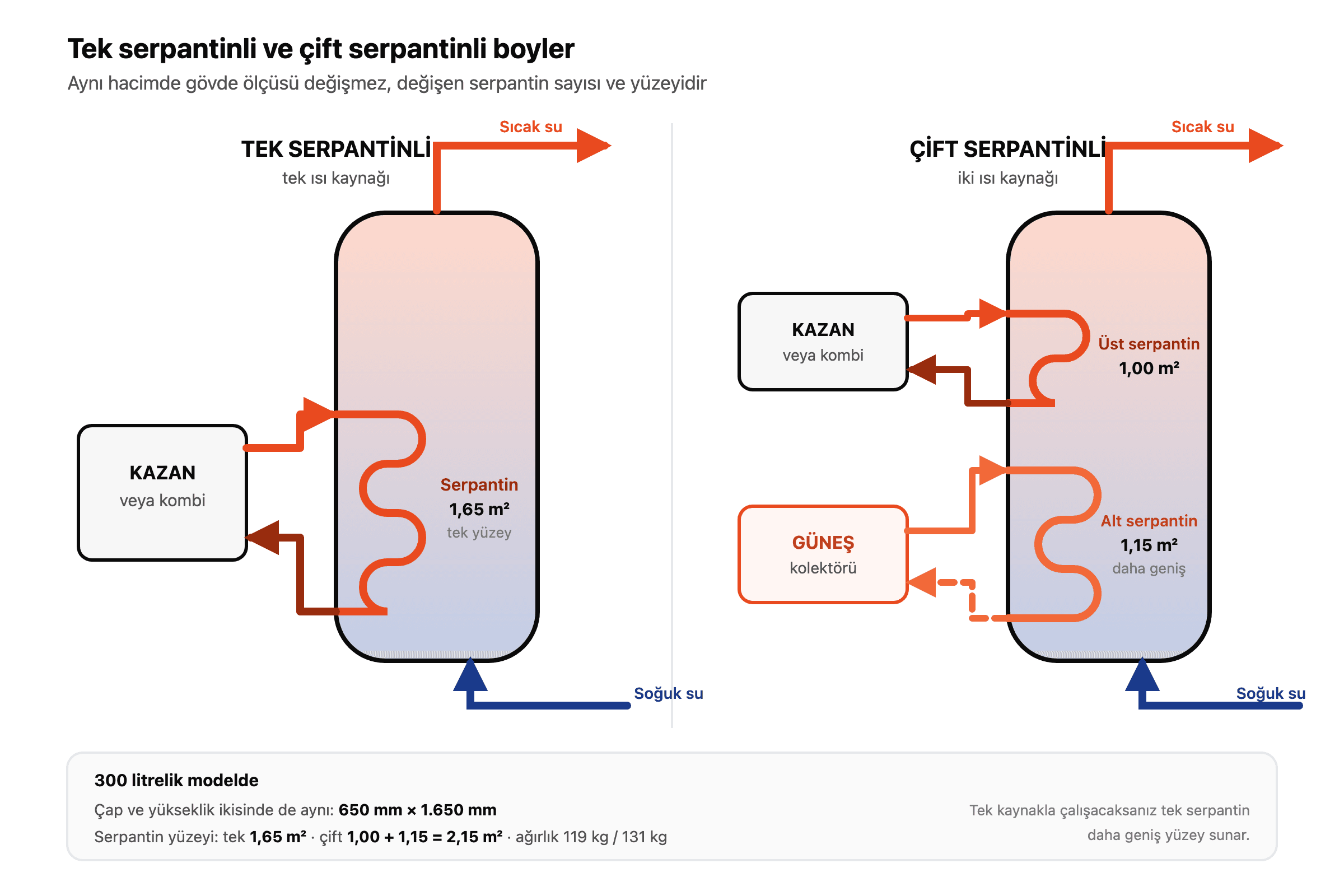
One heat source: a combi boiler, a boiler or a central heating line, and one coil in the body. The most common arrangement in homes, villas and single-source facilities. Sizes and surfaces are in the table above; product page, single coil water heater.
Dual coil water heater
Two heat sources. The lower coil goes to the solar collector circuit, the upper to the combi boiler or boiler. While there is sun the collector works; when it is not enough the boiler takes over. One pattern stands out across all 12 catalogue sizes: the lower coil is larger than the upper at every size.
| Capacity (L) | Upper coil (m²) | Lower coil (m²) |
|---|---|---|
| 160 | 0.51 | 0.61 |
| 200 | 0.6 | 0.95 |
| 300 | 1 | 1.15 |
| 500 | 1.25 | 1.85 |
| 800 | 1.35 | 2 |
| 1000 | 2 | 2.83 |
| 1500 | 2.2 | 2.97 |
| 2000 | 2.97 | 4.25 |
| 2500 | 2.97 | 4.53 |
| 3000 | 4.53 | 5.6 |
| 4000 | 4.8 | 5.95 |
| 5000 | 5.65 | 6.8 |
Not coincidence, a design decision. The solar circuit works at a lower and far more variable temperature than a boiler. As the temperature difference narrows, more surface is needed to pass the same heat, so the lower coil is made larger. For a selection comparison see single or double coil water heater; for the order in which the ports connect, the water heater connection diagram. Product page: double coil water heater.
Heat pump water heater
This is where the logic shows itself most clearly. A heat pump delivers water at a noticeably lower temperature than a boiler. At a small temperature difference, enlarging the surface is the only way to pass the same heat, so the coil in a heat pump water heater is larger than in the single coil model of the same volume.
| Capacity (L) | Single coil (m²) | Dual coil, upper / lower (m²) | Heat pump (m²) | Heat pump / single coil |
|---|---|---|---|---|
| 200 | 1.38 | 0.6 / 0.95 | 2.2 | 1.59 times |
| 300 | 1.65 | 1 / 1.15 | 2.7 | 1.64 times |
| 500 | 2.4 | 1.25 / 1.85 | 3.4 | 1.42 times |
| 800 | 2.9 | 1.35 / 2 | 3.62 | 1.25 times |
| 1000 | 3.5 | 2 / 2.83 | 5.88 | 1.68 times |
The difference runs between 1.25 and 1.68 times. The curve is not smooth in this series either: surface per 100 litres is 1.10 m² at 200 litres, falls to 0.45 m² at 800 litres, then climbs back to 0.59 m² at 1,000 litres.
The point is useful at selection. A heat pump cannot be connected by reading the litres of a standard single coil water heater. The litres may work out while the surface does not; the system runs, but heats the water more slowly than you expected.
Coil material: enamelled steel, copper, stainless
Three materials are used, and the difference between them is mostly corrosion behaviour and maintenance access.
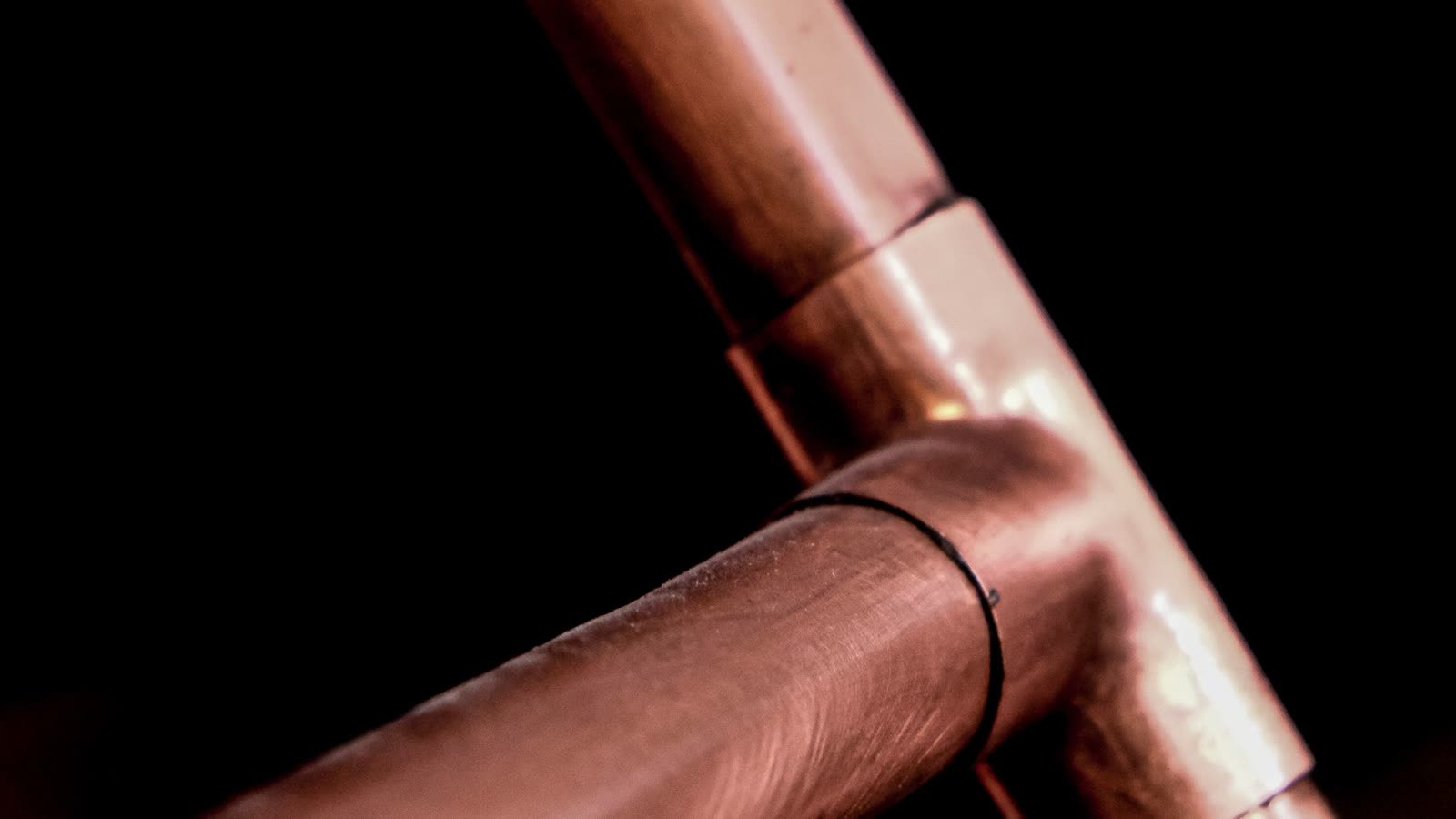 Close-up of copper tube and a soldered elbow joint. Copper is the material used in removable coils; the tube is joined by soldering and wound so it can be withdrawn from the body
Enamel coated steel is the standard. Coil and tank inner surface are coated with enamel; the coating comes between water and metal and leaves a surface fit for drinking water quality. It is integral to the body and does not come out.
Copper brings its real gain in removability. On the removable copper single coil and removable copper double coil models the coil is withdrawn through a flange, cleaned outside the tank and replaced when needed. In hard water regions, and where a maintenance shutdown is expensive, that access decides it.
Stainless steel is chemically durable and, not depending on the integrity of a coating, carries no risk of coating damage.
The question at selection is not which material conducts better; it is water hardness, operating conditions, and whether you can get into the body for maintenance.
The difference between a heating coil and a heat exchanger
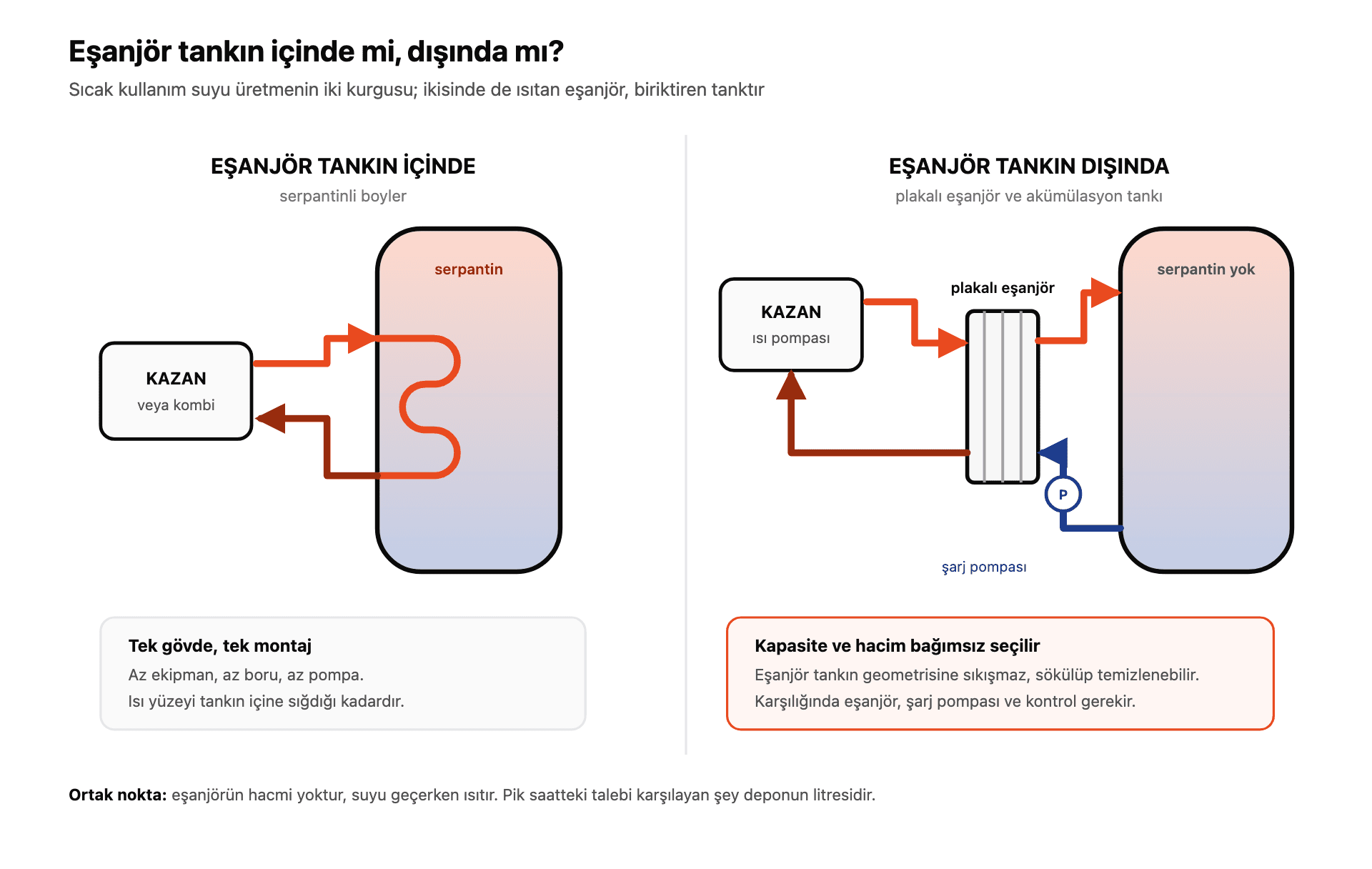
Technically there is no difference: a heating coil is a heat exchanger. The difference is position, and how freely it can be sized.
The coil is inside the tank, so its surface is limited to what fits that geometry; capacity and volume are tied together, and enlarging one means enlarging the other. A plate heat exchanger sits outside. Its capacity is chosen independently of the litres in the store, it can be enlarged, and it can be removed from the circuit and cleaned. In return a pump, controls and extra pipework enter the system.
That is why there is no coil inside a hot water storage tank; the water is heated outside and pumped in. For the full set of types, the working principle and a plate-versus-coil comparison, see our what is a heat exchanger article.
Coil maintenance and scale
Scale is what a coil has to fear. The layer that builds on the transfer surface behaves like insulation; the area stays the same on paper while effective transfer drops. The m² value in the catalogue is a design value, not the performance of a scaled coil.
Symptoms show up in three places: tap water is not as hot as it was, recovery time lengthens, and the heat source runs longer for the same result. All three together, and scale is the first place to look.
On removable copper models the pipe is withdrawn and cleaned outside the tank. On enamel coated bodies the work runs from the tank side, and a method that will not damage the coating has to be chosen. For methods and order of work see our how to clean a water heater article.
No interval suits everyone. Water hardness and operating temperature set it, and it shortens noticeably in hard water.
Frequently asked questions
What does the word coil mean here?
A heating coil is a curved bundle of pipe that passes heat from a fluid into another medium. The Turkish term, "serpantin", comes from a root meaning snake, because the pipe winds like one. It covers both the heating pipe inside a water heater and the finned pipe bundle in an air conditioner.
What is a coil water heater?
A hot water store with one or two coils placed inside it. Hot water from a boiler, a combi boiler, a solar collector or a heat pump passes through the coil, heats the domestic water in the tank and returns to its own circuit without mixing with it. One body both heats and stores.
Are a heating coil and a heat exchanger the same thing?
A heating coil is a type of heat exchanger, the one buried inside the tank. A plate heat exchanger stands outside, and its capacity can be chosen independently of the litres in the store. For detail see what is a heat exchanger.
Why does coil surface matter when choosing a water heater?
Litres tell you how much water you hold; coil surface tells you how fast you heat it. Surface per litre falls as volume grows: in the Omega catalogue 0.61 m² per 100 L at 100 litres, 0.19 m² per 100 L at 5,000 litres. A large tank does not recover proportionally faster, and in facilities with steady consumption that difference sets comfort directly.
Why is the coil larger in a heat pump water heater?
A heat pump delivers water at a lower temperature than a boiler. As the temperature difference narrows, more surface is needed to pass the same heat. Against the single coil model of the same volume in the catalogue, the difference runs between 1.25 and 1.68 times.
How do I tell the coil has scaled up?
Outlet water temperature falls, recovery time lengthens, and the heat source runs longer for the same result. In hard water regions these symptoms appear earlier.
The coil is the least talked about part of a water heater selection and the one that decides the outcome most. Settle the litres with our water heater calculator; the surface side changes with the heat source type and the way consumption spreads through the day. For the coil surface and body type suited to your facility, get in touch.