Short answer
Choosing a boiler reduces to three decisions: capacity (how many liters), heat source (central boiler, electric, solar, heat pump), and coil type (single or double). Homes and small facilities typically use 120-500 liters with a coil or heat pump boiler; hotels and healthcare sites standardize on 1,000 liters and above, usually paired with an accumulation tank. Use our boiler sizing tool to calculate capacity numerically, and browse all products in the Boiler category.
How to determine capacity
Boiler capacity is calculated in two steps: total daily demand and the peak-hour load from that demand.
Step 1: Daily hot water demand
Per-person daily consumption varies by facility type. Reference values (cold inlet 10°C, storage 60°C):
| Facility type | Daily consumption per person |
|---|---|
| Residential | 40-60 L/person |
| Hotel (standard room) | 100-130 L/room |
| Healthcare / dormitory | 80-120 L/bed |
| Sports facility / bathhouse | 60-80 L/user |
Step 2: Simultaneity and storage factor
Not all users demand hot water at the same moment. A simultaneity factor is applied to calculate peak load:
| Facility type | Simultaneity factor | Storage factor |
|---|---|---|
| Residential / villa | 0.30 | 0.70 |
| Apartment / complex | 0.30 | 1.25 |
| Hotel / healthcare | 0.25 | 0.80 |
| Hospital | 0.25 | 0.60 |
Practical example: A 10-unit apartment block (average 3 persons per unit):
- Daily total demand: 30 persons x 50 L = 1,500 L
- After simultaneity: 1,500 x 0.30 = 450 L peak load
- After storage factor: 450 x 1.25 = 562 L minimum boiler capacity
When selecting a boiler, stepping up one capacity size is always recommended for recovery time and comfort assurance.
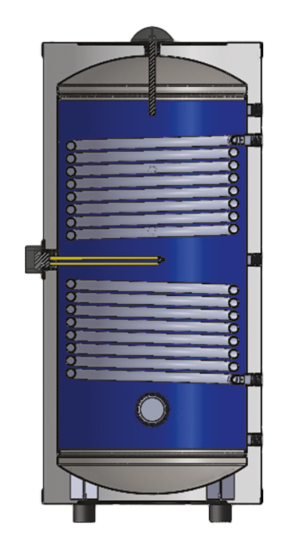
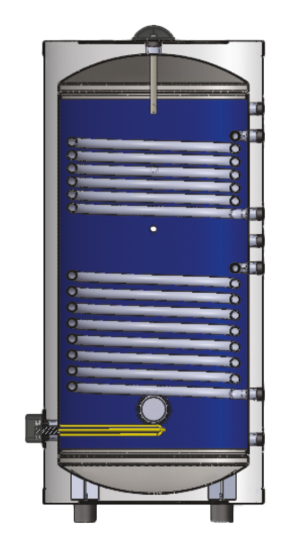 Double coil boiler cutaway showing how two separate heat sources heat water in a single tank
Boiler types: which one and when?
Coil boilers (single and double)
The most common type, fed by a central boiler or heating loop. The coil is an internal pipe through which hot circuit water heats the domestic water without direct contact.
Single coil boiler: The standard for facilities with one heat source. The Single Coil Boiler is the cleanest solution for this case.
Double coil boiler: The right choice when you want to combine two heat sources, for example a boiler and solar collectors, in a single tank. The Double Coil Boiler has become the standard for solar-plus-boiler combined setups.
Removable copper coil models: In regions with hard water or where service ease is a priority, models with physically removable coils simplify descaling and maintenance. The Removable Copper Single Coil and Removable Copper Double Coil cover this need.
Electric and Smart series
A standalone solution for homes without central boiler infrastructure, holiday properties, and independent units. The Electric Boiler covers basic needs; for digital control panel, remote access and an antibacterial mode, the Smart Series Electric Boiler offers a more comprehensive feature set.
Heat pump boiler
These systems extract heat from the air and multiply electrical energy by a factor of 3-4. The Heat Pump Boiler significantly reduces annual running cost at home and villa scale and is among the fastest-payback options available.
 Heat pump boiler technical cutaway and connection diagram
Solar boiler
In high-irradiation regions it minimizes the cost of hot water. The Solar Boiler (120-300 L) is designed for homes and villas; the Solar Boiler (500-1,250 L) suits apartment and small facility scale.
Horizontal jacket boilers
Where vertical space is limited in basements or plant rooms, the Horizontal Jacket Boiler offers a placement advantage. For setups requiring high recovery capacity, the Horizontal Jacket Firkete-Coil Boiler is the preferred choice.
Quick selection table by facility type
| Facility type | Recommended capacity | Recommended type |
|---|---|---|
| Residential / villa (3-5 persons) | 120-300 L | Single coil or heat pump |
| Apartment (10-20 units) | 500-1,000 L | Double coil + accumulation |
| Small hotel (20-50 rooms) | 1,000-3,000 L | Double coil + accumulation tank |
| Large hotel / healthcare | 3,000 L+ | Multiple boilers + accumulation system |
| Holiday / independent unit | 80-150 L | Electric or solar boiler |
| High-irradiation region | 120-300 L (residential) | Solar boiler + backup boiler |
For facilities where separating storage from production is advantageous, see our Accumulation Tank page.
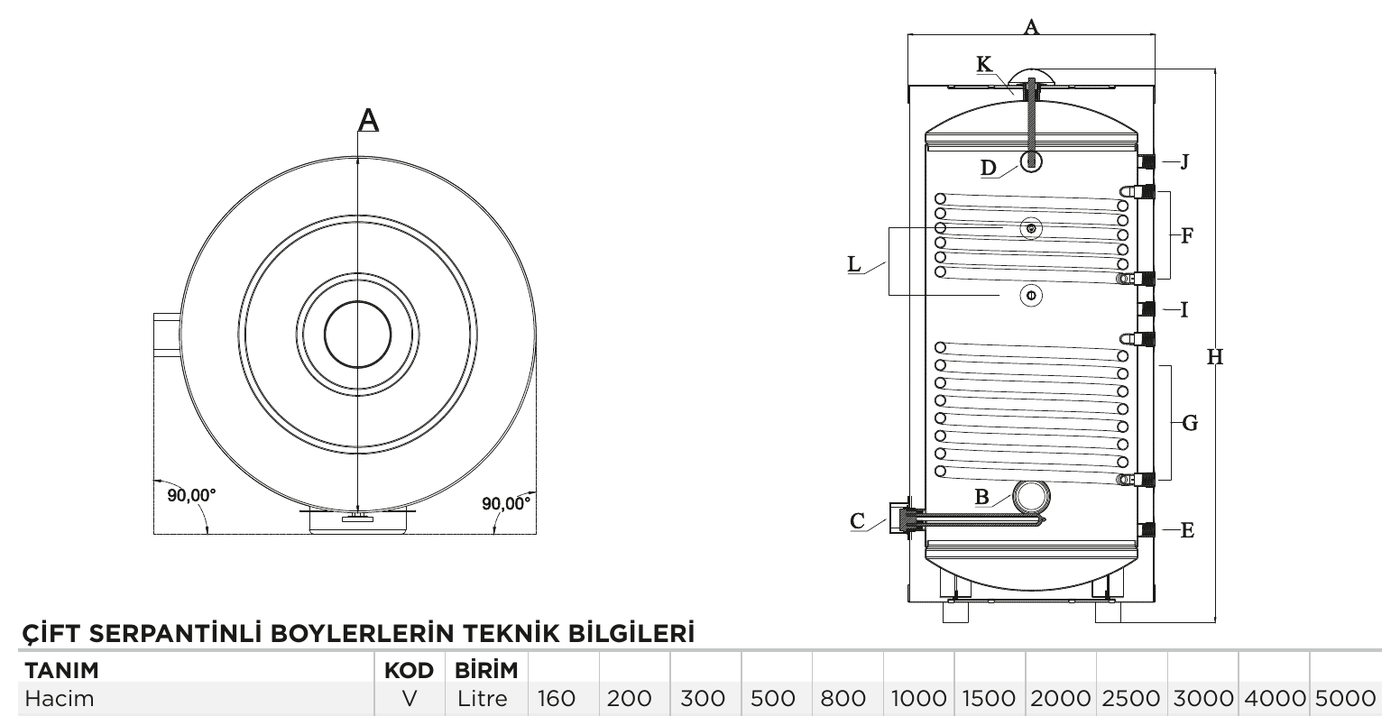 Double coil boiler technical drawing with connection ports and dimensions
Frequently asked questions
Should I increase capacity or add an accumulation tank?
If peak demand is high and sustained, adding an accumulation tank is both more efficient and more economical than simply enlarging the boiler. The boiler runs continuously to fill the tank, and stored volume discharges during the peak. This setup also improves boiler efficiency.
Is a double coil boiler really necessary?
If you have only one heat source, a single coil boiler is sufficient. A double coil becomes essential when combining two sources such as solar collectors and a boiler. If you plan to add solar in the future, choosing a double coil at the installation stage avoids additional costs later.
In what conditions does a heat pump boiler perform efficiently?
Heat pump boilers operate efficiently at air temperatures of 5°C and above. Efficiency drops at lower temperatures in winter; for cold-climate regions, models with a built-in backup electric element are recommended.
What storage temperature prevents Legionella growth?
Keeping storage temperature at 60°C prevents Legionella bacteria from multiplying. The boiler thermostat should be set to 60°C, and periodic thermal disinfection should be performed by raising the temperature to 70°C at regular intervals. The Smart Series antibacterial mode automates this process.
Use the boiler sizing tool to see capacity figures numerically. For a custom design at facility scale, get in touch with us and we will determine the right size and type together.