
Short answer
Cleaning a water heater comes down to four steps: isolate the power and the heat source, drain the tank completely through the drain port, remove the inspection flange and lift out the sediment and scale that has settled at the bottom, then measure the magnesium anode rod and replace it if it is spent. On a glass-lined (enamelled) tank, using concentrated acid descaler carelessly ruins the lining permanently, so the weight of the job belongs on mechanical sediment removal, not on chemicals. For hotels and inpatient healthcare facilities in Turkey this is not optional: the Legionella regulation requires hot water tanks to be drained, cleaned and disinfected at least three times a year. Below we cover both the required intervals and the steps used in the field.
How often should a water heater be cleaned?
The answer depends on the type of facility, and part of it is law rather than advice.
In Turkey, hotels, motels, holiday villages, nursing homes, care homes, thermal spas and inpatient healthcare facilities fall under the Legionella Disease Control Regulation (Official Gazette no. 29354, 13 May 2015). The Ministry of Health's Legionella Control Programme Guide covers the implementation detail. Article 8 sets out the following obligations for hot water systems:
| Obligation | Frequency | Reference |
|---|---|---|
| Hot water tank drained, cleaned and disinfected | At least 3 times a year | Art. 8/1(a) |
| Cold water tank drained, cleaned and disinfected | At least 2 times a year | Art. 8/1(a) |
| Physical inspections | Monthly | Art. 8/1(b) |
| System disinfection | At least once a year | Art. 8/1(b) |
| Hot water tank temperature | Minimum 60 °C year-round | Art. 8/1(ç) |
| Temperature at taps and shower heads | 50-60 °C within one minute | Art. 8/1(f) |
Outside that scope, in homes, residential complexes, offices and factories, there is no legally fixed interval. The practical measure there is water hardness: once a year in hard water areas, once every two years in soft water areas is a sensible full-clean interval. Anode rod inspection, however, should be annual regardless of water hardness.
The technical tension the rule creates
There is an engineering point worth pausing on. The regulation requires water to be held at a minimum of 60 °C to suppress Legionella growth, but calcium carbonate precipitation also accelerates above that same temperature band. A facility that complies with the rule is, unavoidably, operating a water heater that scales up faster.
The answer is not to lower the temperature, which would be both unlawful and a health risk. The answer is to treat scaling as a planned maintenance item rather than a fault. The three-times-a-year draining requirement was written with exactly that logic.
Safety and preparation before cleaning
Before any cleaning begins, work through this order:
- Shut down the heat source. On an electric unit, switch off the breaker. On a coil-type tank fed by a boiler, take the boiler offline and close the isolating valves on the coil circuit.
- Let the tank cool. Working with water above 60 °C carries a scalding risk. On large tanks this wait can run to several hours.
- Close the cold water inlet valve. Essential so the mains does not refill the tank while it drains.
- Open a hot water tap. This prevents a vacuum forming at the top of the tank and lets the water run out cleanly.
- Prepare the drain line. Fit a hose to the drain port at the lowest point of the tank and route it to a floor drain.
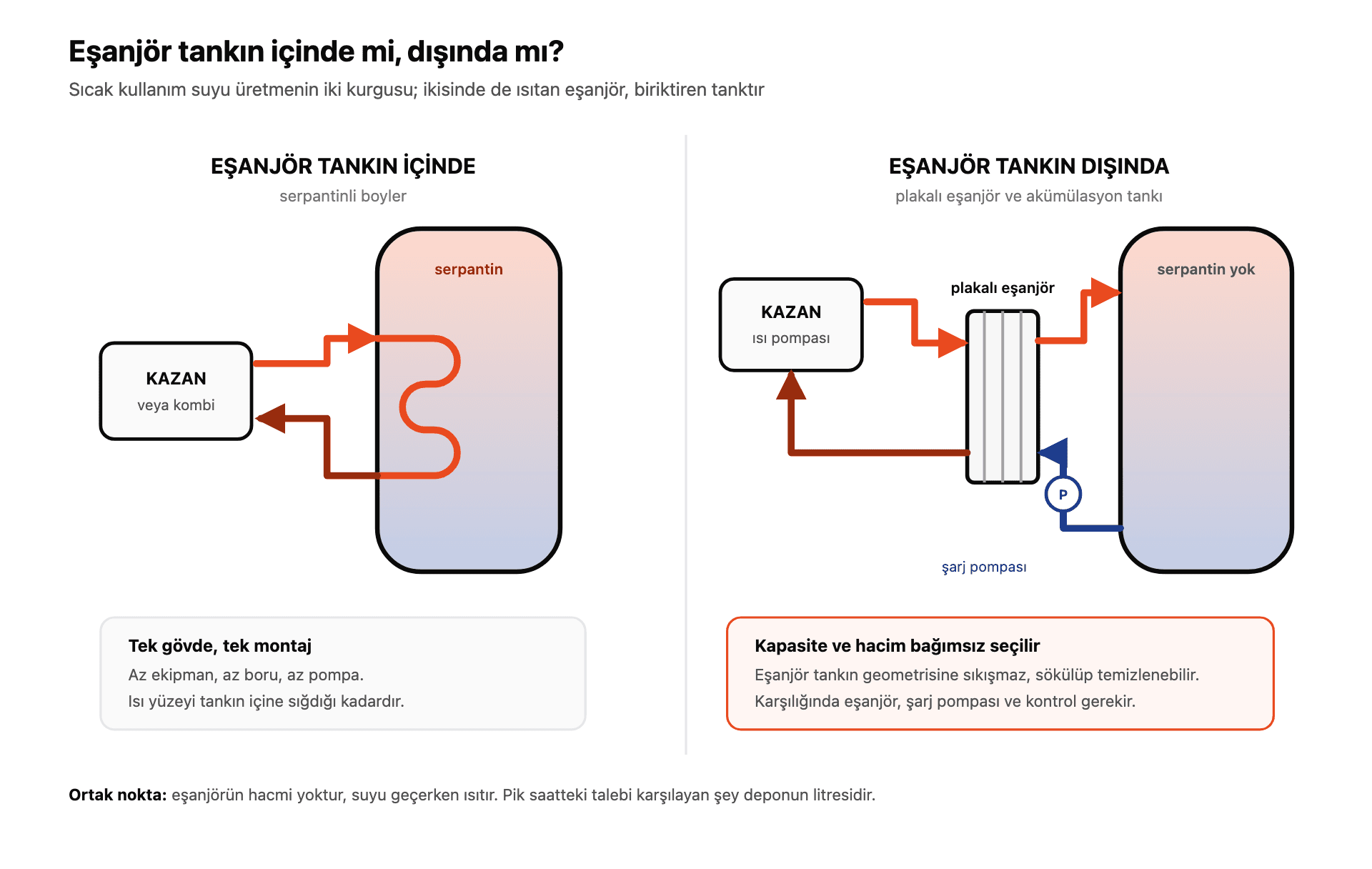
Skipping these steps usually creates a bigger problem than the cleaning itself. Firing a heating element or a coil that has been left dry means permanent damage. If you are unsure which port on the tank does what, our water heater connection diagram article covers all nine connection points one by one.
How to clean a water heater step by step
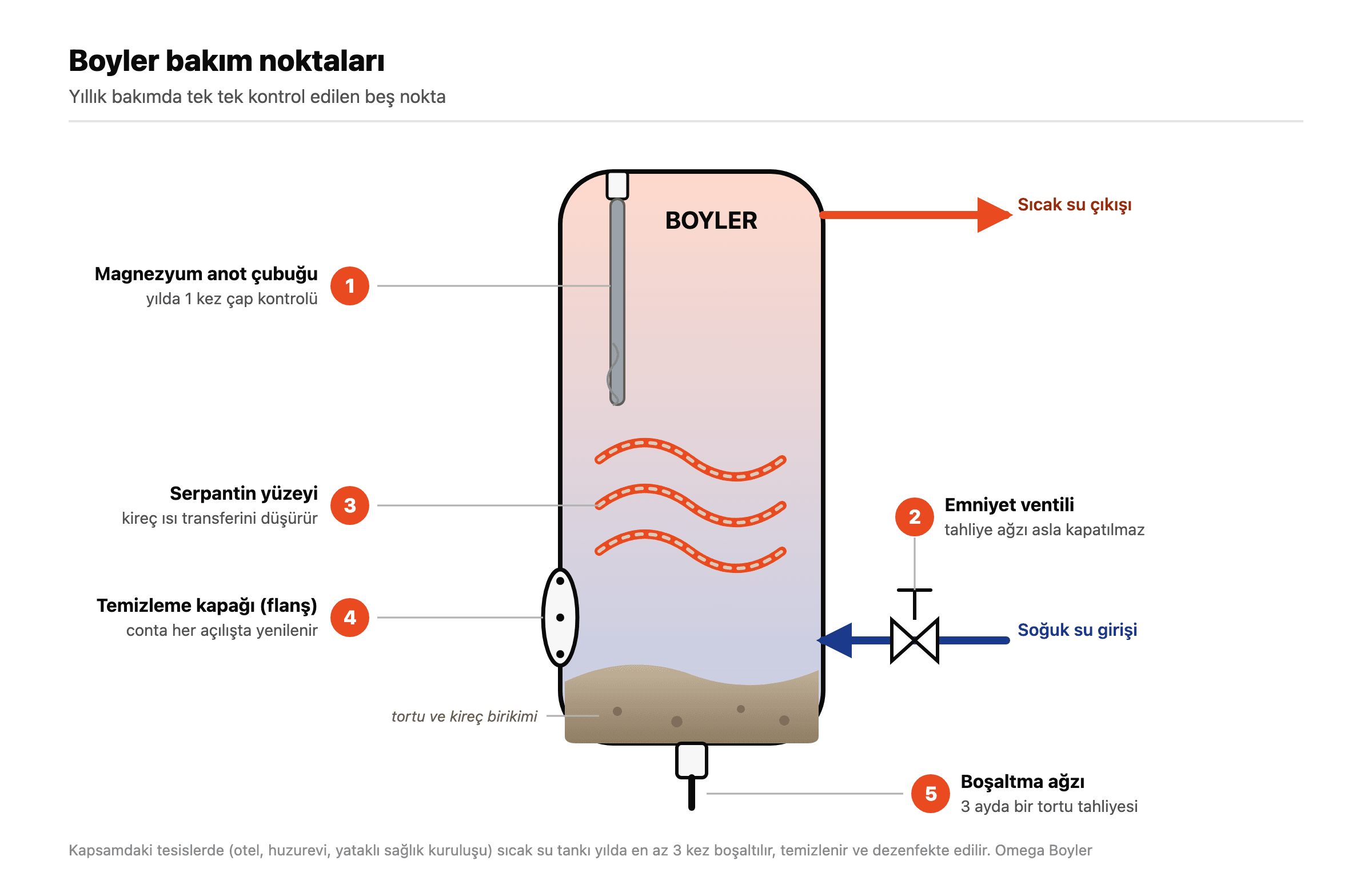
The sequence below applies to most coil-type and electric water heaters. The five points on the diagram are the ones the steps walk through.
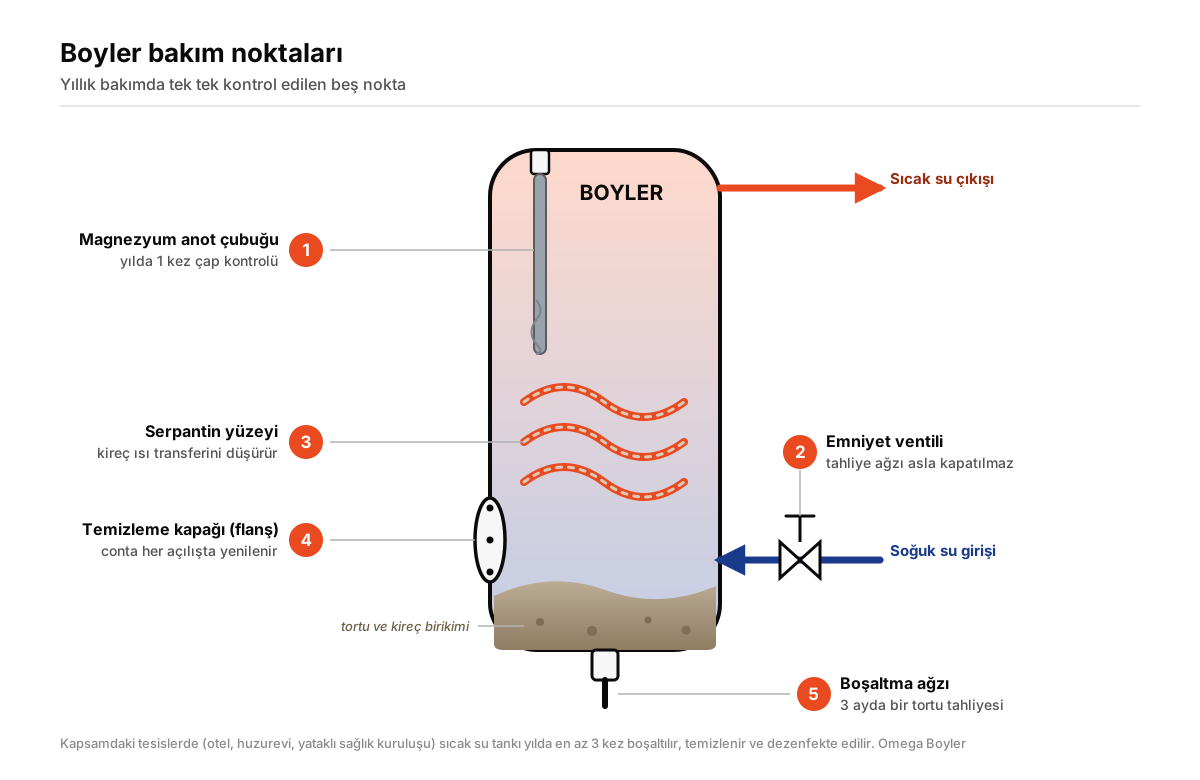 Water heater maintenance points: magnesium anode rod, safety relief valve, coil surface, inspection flange and drain port, with sediment settled at the bottom
- Drain the tank completely. The first water out of the drain port is normally cloudy and full of sediment. Letting it run until it clears carries out part of the loose sludge on its own.
- Remove the inspection flange. Loosen the bolts in a crosswise sequence. The gasket is usually deformed once the cover comes off; it is not reused, it is replaced.
- Remove the sediment mechanically. Work with a plastic scraper, a soft brush and a wet-dry vacuum. Do not use metal scrapers, wire brushes or abrasives; a micro-scratch in the enamel becomes the starting point for corrosion.
- Rinse the tank interior. Open and close the cold water valve in short bursts so the remaining sediment is swept out through the drain port. Repeat until the water running out is clean.
- Inspect the magnesium anode rod. Detail below. This is the most frequently skipped step and the most expensive one to skip.
- Refit the cover with a new gasket. Tighten the bolts crosswise again, in stages. Tightening from one side crushes the gasket and causes leaks.
- Refill and check for leaks. Wait until all air has left through the hot tap you left open, then close it. Wipe around the flange with a dry cloth to check.
- Bring the heat source back online. Only start the boiler or heating element once the tank is confirmed completely full.
In facilities within the regulation's scope, disinfection follows these steps. Thermal disinfection (temporarily raising the temperature and flushing every outlet) or chemical disinfection can be used; which one applies depends on the facility's risk assessment and is normally carried out and documented by an accredited contractor.
Why scale forms, and where it forms fastest
Scale is what happens when the calcium and magnesium compounds in mains water lose solubility as they heat and precipitate onto the tank surface and the heating element. The harder the water, the faster it happens.
Water hardness varies sharply between regions, and your local water authority publishes the figure for your supply. The practical rule is straightforward: as hardness rises, the cleaning interval shortens, and in very hard water areas maintenance alone is not enough. A softening system needs to be added to the installation.
Scale does damage in three ways:
- Heat transfer drops. Scale built up on a coil or heating element behaves like insulation. Producing the same hot water then takes longer and burns more fuel.
- Element life shortens. Heat trapped under the scale layer drives the element's own surface temperature up and burns it out.
- Capacity disappears. Sediment on the bottom effectively shrinks the usable storage volume. A 500-litre tank starts delivering measurably less hot water.
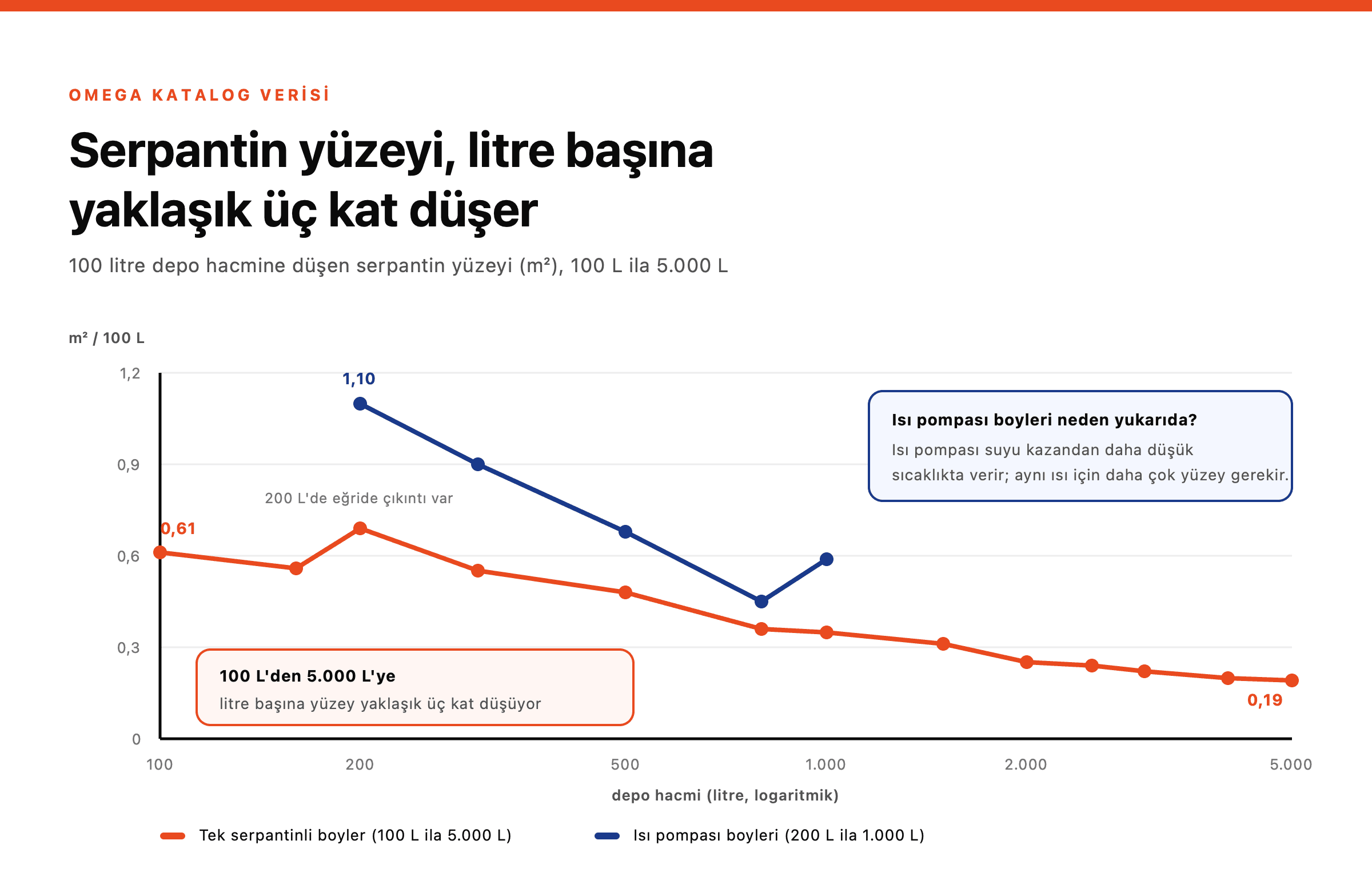
For facilities that fight scale constantly, there is also a product choice that makes maintenance easier: on a removable copper single-coil water heater, the coil can be withdrawn from the tank, so descaling is done outside the tank rather than inside it. It was designed for exactly the hard water case.
How to check a magnesium anode rod
The anode rod is the cheapest and most critical component in a water heater. Invisible micro-pores always exist in an enamel lining, and the steel exposed at those points corrodes. Magnesium is a more active metal than steel, so it draws the corrosion onto itself and dissolves over time. That is why it is called a sacrificial anode.
When the anode is spent, protection ends and corrosion moves directly to the tank wall. Past that point there is nothing to be done, the tank is replaced. A component worth a few hundred lira, left unchecked, takes the whole tank with it.
What to look for
The anode rod normally unscrews from a port in the top cover, near the thermometer pocket. Once out, the thing to judge is its diameter:
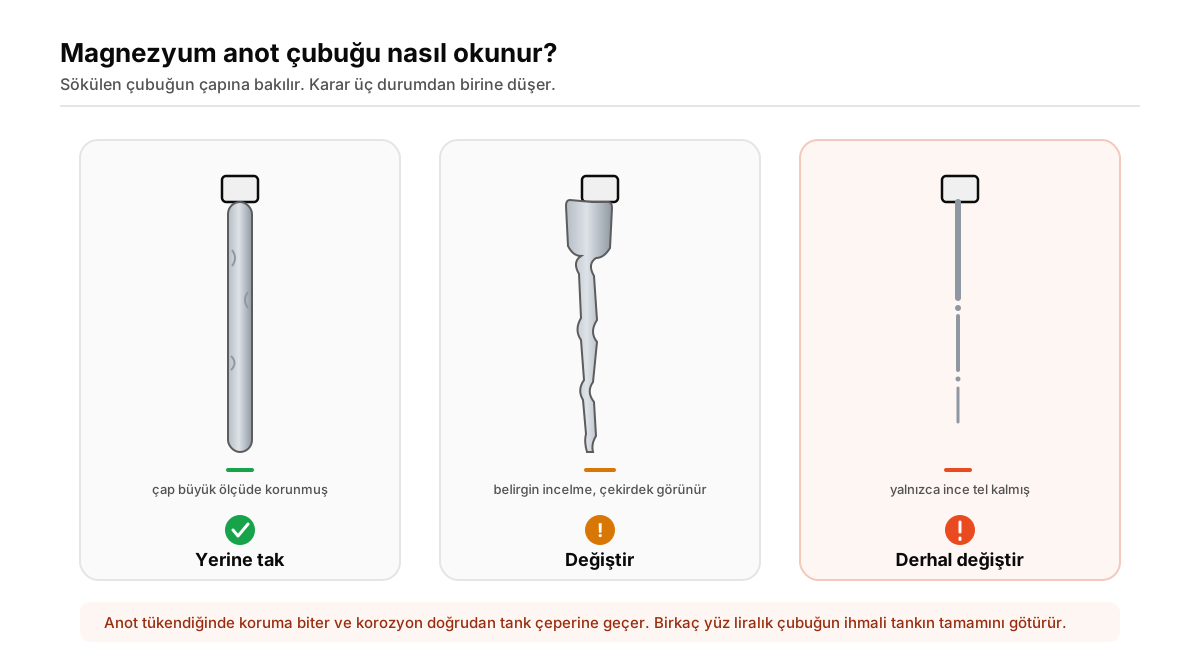 Three wear states of a magnesium anode rod: an intact rod is refitted, a visibly thinned rod is replaced, and a rod reduced to a thin wire is replaced immediately
| Condition of the rod | Reading | Action |
|---|---|---|
| Diameter largely intact, light surface pitting | Normal wear | Refit, inspect again in a year |
| Diameter visibly reduced, core wire showing in places | Nearing end of life | Replace |
| Only a thin wire left, or the rod has broken up | Protection has ended | Replace immediately and inspect the tank interior for corrosion |
Inspection should be annual. The consumption rate depends on water hardness, temperature and how heavily the tank is used; an anode in a hotel water heater running hot and hard will erode far faster than one in a domestic unit.
The tank has to be drained to remove the anode rod, which is why it makes sense to do this check during the annual clean. Planning the two jobs separately means draining the tank twice.
Should you use acid descaler on an enamelled water heater?
Short answer: with great care, and preferably not.
Enamel is a glass-based lining fused onto the inner steel surface at high temperature. Its resistance to water and corrosion is excellent, its resistance to strong acids is not. Some concentrated descalers sold on the market, used at the wrong dilution or left to sit too long, produce dull patches, cracks and porosity in the lining. Once the lining is compromised, the tank's protection mechanism collapses, and the anode rod cannot carry that load on its own.
The correct field approach is:
- The primary method is mechanical sediment removal, not chemical.
- If a chemical is necessary, use a product the manufacturer has approved for enamelled tanks, at the labelled dilution, without exceeding the stated dwell time.
- Rinse the tank thoroughly and repeatedly afterwards; residual chemical harms both the lining and the user.
- Household remedies such as vinegar may be arguable on small domestic appliances, but on a facility-scale tank they are neither sufficient nor practical.
Removable parts such as heating elements and coils are a different matter. These can be taken out and soaked in descaler in a separate container, because no enamel lining is involved.
Annual maintenance calendar
A practical summary for facility managers:
| Interval | Task |
|---|---|
| Monthly | Temperature readings (tank and end points), visual leak check, confirm the relief valve discharge is unobstructed |
| Quarterly | Flush sediment from the drain port (a few minutes of running, without fully draining) |
| 3 times a year (facilities in scope) | Full drain, clean and disinfection |
| Annually | Magnesium anode rod inspection, flange gasket replacement, relief valve and expansion vessel check |
| Annually (facilities in scope) | System disinfection and documentation |
Recording this calendar in the facility's maintenance log is the simplest evidence you can present at an inspection.
Frequently asked questions
Can I clean a water heater myself?
On a small domestic unit, draining and rinsing is within reach of a homeowner. Flange removal, anode replacement and disinfection require plumbing knowledge. In facilities within the regulation's scope the work has to be documented, so an authorised service provider is required.
How long does cleaning take?
On a domestic tank, draining and rinsing takes a few hours. On a facility-scale tank, once cooling time is added, the job usually spreads across half a day. The hot water outage needs to be announced to the operator in advance.
How do I know my water heater has scaled up?
The typical signs are: less hot water at the same setting, longer heat-up times, crackling noises from the tank, occasional white particles at the tap, and an unexplained rise in energy bills. On electric models, an element that keeps failing is a strong indicator.
What happens if the anode rod is never replaced?
Once the anode is gone, corrosion targets the tank wall directly. It normally starts at the bottom, under the sediment, and by the time it is noticed the wall has perforated. Repair is not viable, so the tank is replaced in full.
Can I reduce scaling by lowering the water temperature?
In a home, to a degree. In facilities within the regulation's scope, no: the rule requires a minimum of 60 °C in the hot water tank year-round. Legionella risk far outweighs the cost of scale. The right approach is not a lower temperature but adherence to the maintenance interval.
Is an accumulation tank cleaned the same way?
The principle is identical: drain, remove sediment mechanically, check the anode. The differences are that an accumulation tank has no coil and the volumes are usually larger, which extends both draining and cooling time.
Cleaning is the cheapest and highest-return maintenance you can perform on a hot water system: one day of work adds years to the life of the tank. If you want to check whether your current capacity meets demand, our water heater sizing tool will tell you, and our what is a water heater article covers the differences between tank types. To discuss maintenance or replacement of your existing unit, get in touch and we will work out the right solution for your facility.