
Short answer
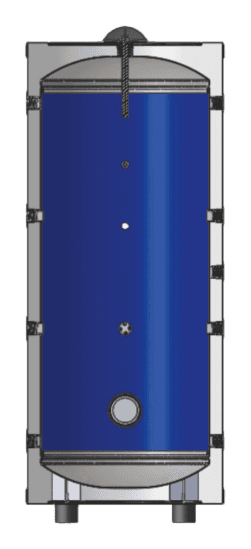
An accumulation tank is an enamel-lined, high-insulated water tank that stores the domestic hot water a heat source produces. A boiler, solar system or heat pump heats the water; the accumulation tank stores it and meets peak demand in facilities where many users draw hot water at once, such as hotels, hospitals and dormitories. It is made from 50 to 5,000 liters. For product details see the accumulation tank page, and for capacity sizing use our water heater sizing tool.
What is an accumulation tank?
An accumulation tank is a storage tank that separates production from consumption. The water inside is domestic water — it goes straight to taps and showers. For this reason an accumulation tank, just like a water heater, is built with two protective layers:
- Enamel inner coating: Keeps the inner surface that contacts domestic water hygienic and corrosion-resistant.
- Cathodic protection (anode rod): Protects the tank against electrochemical corrosion.
These two features are what set an accumulation tank apart from a buffer tank: a buffer tank holds closed-loop heating water, and because that water never reaches a tap, it needs no inner coating. The two tanks do different jobs, a distinction we cover in detail in our accumulation tank vs. buffer tank article.
What does an accumulation tank do?
The job of an accumulation tank is to store the hot water a heat source produces and deliver it at sufficient flow during peak demand.
An example: in a 40-room hotel, dozens of showers run at once between 07:00 and 09:00. Sizing the boiler large enough to cover that instantaneous demand is both expensive and inefficient. Instead, the boiler runs at a smaller output through the night to fill the accumulation tank; at the morning peak, the stored volume takes over. As a result:
- The heat source can be smaller and more efficient.
- No hot-water shortage occurs at peak.
- The boiler runs steadily instead of switching on and off constantly, extending its life.
In short, an accumulation tank meets instantaneous power demand with stored volume, making the system both economical and comfortable.
How does an accumulation tank work?
An accumulation tank produces no heat of its own; it works together with a heat source. The cycle has three steps:
- Heating: A boiler, solar system or heat pump heats the water and transfers it to the accumulation tank. Since the tank has no coil inside it, the transfer usually happens through a plate heat exchanger outside the tank.
- Storage: The heated water waits in the high-insulated tank, holding its temperature.
- Use: When taps open, the tank delivers its stored hot water at sufficient flow, while the heat source begins refilling it.
Because this cycle separates storage from production, it smooths out the swings in a facility's hot-water demand.
Where is an accumulation tank used?
An accumulation tank is a standard component of facilities with simultaneous, high hot-water demand:
- Hotels and resorts: Serve hundreds of users at morning and evening peaks.
- Hospitals and healthcare: Critical settings requiring uninterrupted, hygienic hot water.
- Dormitories and housing complexes: Buildings with intensive multi-point, simultaneous use.
- Sports facilities and baths: Usage profiles needing high flow in a short time.
In these facilities the accumulation tank is usually set up together with a coil water heater or directly with a boiler/solar system.
How is capacity determined?
The right accumulation tank volume is calculated from the facility's simultaneous hot-water demand, the number of users, and the heat source's hourly recovery capacity. A practical approach is to store the difference between the volume the heat source produces per hour and the net demand at the peak hour.
For a numeric result use our water heater sizing tool, and review capacity and type selection by facility scale in our water heater selection guide.
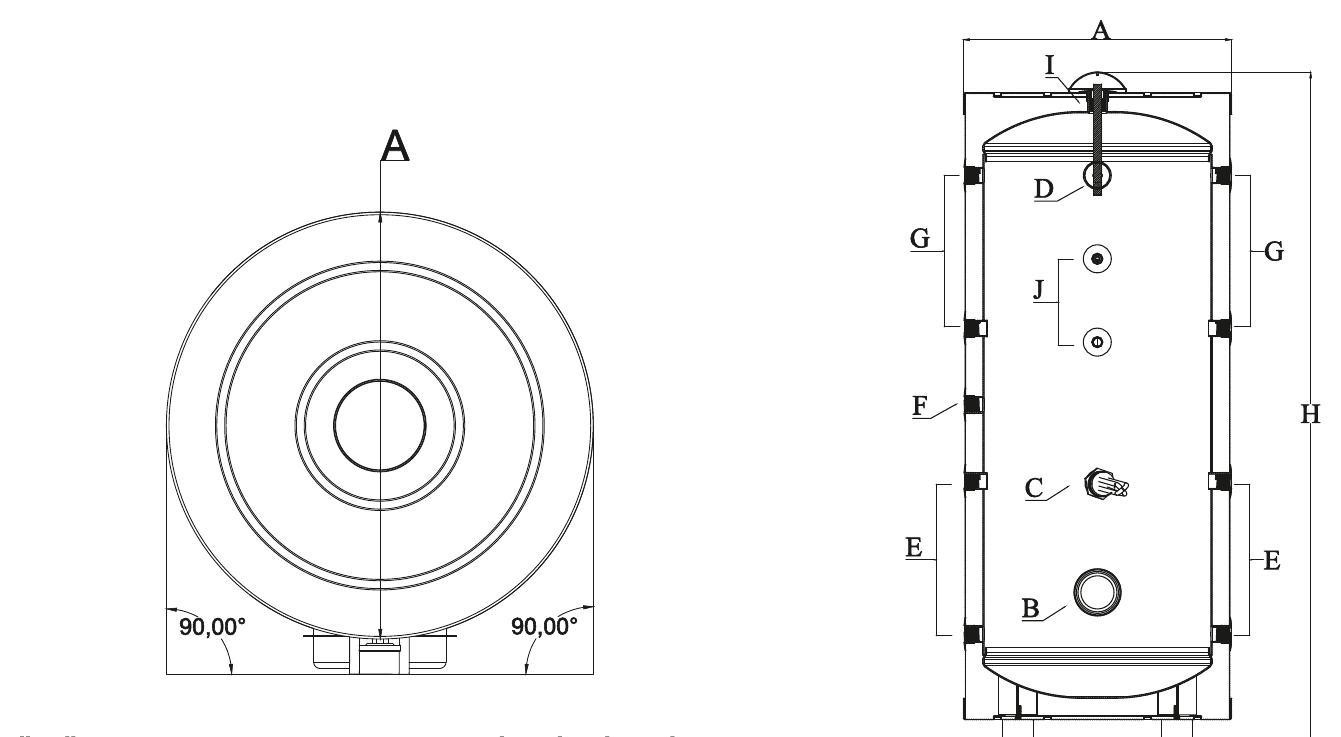 Technical dimension and connection diagram of an accumulation tank
Frequently asked questions
What does an accumulation tank do?
An accumulation tank stores the domestic hot water produced by a boiler, solar system or heat pump and delivers sufficient flow at peak demand. In facilities with simultaneous high demand such as hotels, hospitals and dormitories, it prevents hot-water shortages.
What is the difference between an accumulation tank and a water heater?
A water heater is a tank that actively heats water with an internal coil or resistance element. An accumulation tank has no heating element of its own; it only stores water heated by another source. In most facilities the two are connected in series: the water heater heats, the accumulation tank stores. For more on water heaters, see our what is a water heater article.
Is an accumulation tank the same as a buffer tank?
No. An accumulation tank stores domestic water, so it has an enamel inner coating and cathodic protection. A buffer tank holds closed-loop heating water and, because it does not contact domestic water, needs no inner coating. You can find a detailed comparison in our accumulation tank vs. buffer tank article.
How many liters of accumulation tank are needed?
The right capacity depends on the facility's simultaneous demand; a few hundred liters may suffice at residential scale, while hotels and hospitals prefer capacities of 1,000 liters and above. Omega accumulation tanks are made from 50 to 5,000 liters. For an exact figure, use our water heater sizing tool.
To determine the capacity that fits your facility's hot-water needs, use the water heater sizing tool or get in touch with us. Let's determine the right accumulation tank and system setup together.