
Short answer
A heat exchanger transfers heat between two fluids without letting them mix. The transfer happens across a metal surface: the hot fluid flows along one side, the cold fluid along the other, heat conducts through the wall, and the two circuits never touch. The common types are plate, shell-and-tube and coil exchangers. For domestic hot water there is one point worth knowing up front: an exchanger has no volume, only an instantaneous transfer capacity. It heats water as the water passes through; it does not hold it. That is why in a central system an exchanger is never installed alone but alongside a water heater or an accumulation tank. Below we set out how an exchanger works, the types available, and how it pairs with storage.
What does a heat exchanger do?
A heat exchanger does three jobs, and most installations want all three at once.
Separation. Boiler circuit water carries additives, circulates through the pipework and is not the same water you drink from a tap. The exchanger keeps the two apart. In solar installations the collector circuit carries an antifreeze fluid, and it is the exchanger that stops that fluid reaching the domestic water.
Transfer. While keeping the fluids apart it lets the heat through, moving the energy one circuit produces into another circuit.
Recovery. Heat in a fluid that would otherwise be discarded can pre-heat the cold fluid entering the system. The exchanger is where that handover happens.
How a heat exchanger works
An exchanger has two sides. The primary side is the circuit giving heat up: a boiler, a heat pump, a solar collector or a process fluid. The secondary side is the circuit taking heat on; in domestic hot water systems that is the water heading for the tap.
The two fluids run through separate channels with a thin metal surface between them, and heat conducts across that surface. The wider the surface and the greater the temperature difference between the sides, the more heat moves in the same time. Every exchanger design is an attempt to enlarge those two variables.
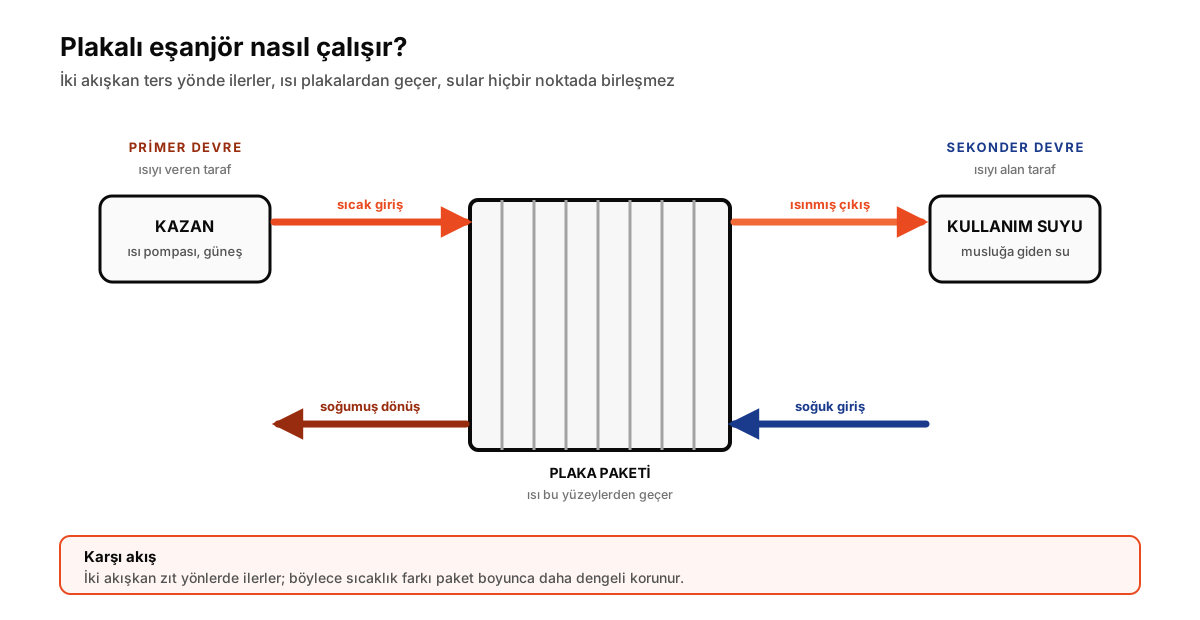 How a plate heat exchanger works: the primary and secondary circuits run in counter-flow, heat passes through the plates, and the two fluids never meet
Flow direction changes the outcome too. When both fluids travel the same way it is called parallel flow: the temperature difference is large at the inlet but closes quickly along the run. When they travel in opposite directions it is counter-flow, and the difference holds more evenly across the whole length. Counter-flow is the common choice in hot water applications.
There is also the resistance a fluid meets passing through. As channels narrow and surface grows, that resistance rises. Pump selection therefore cannot be made independently of the exchanger; the unit you choose determines the pump the circuit needs.
Heat exchanger types
Exchangers are grouped by how they build their transfer surface.
Plate heat exchanger
The most widely used type. Thin, pressed metal plates are stacked, forming narrow channels between them. The fluids pass through alternate channels: primary in one, secondary in the next. Because it packs a very large surface into a small volume, it is compact.
It splits into two groups. In a gasketed plate exchanger the plates are clamped in a frame; they can be taken apart and cleaned individually, and capacity can be raised by adding plates. In a brazed plate exchanger the plates are permanently joined; it is more compact but cannot be opened, so cleaning is done in place by circulating a chemical.
In central domestic hot water and heat pump arrangements the plate type has become the default.
Shell-and-tube heat exchanger
A tube bundle sits inside a shell; one fluid runs through the tubes, the other through the shell space around them. It tolerates high pressure and fluids carrying particles better than the plate type. In return it takes more room for the same heat load.
Coil: the exchanger inside the tank
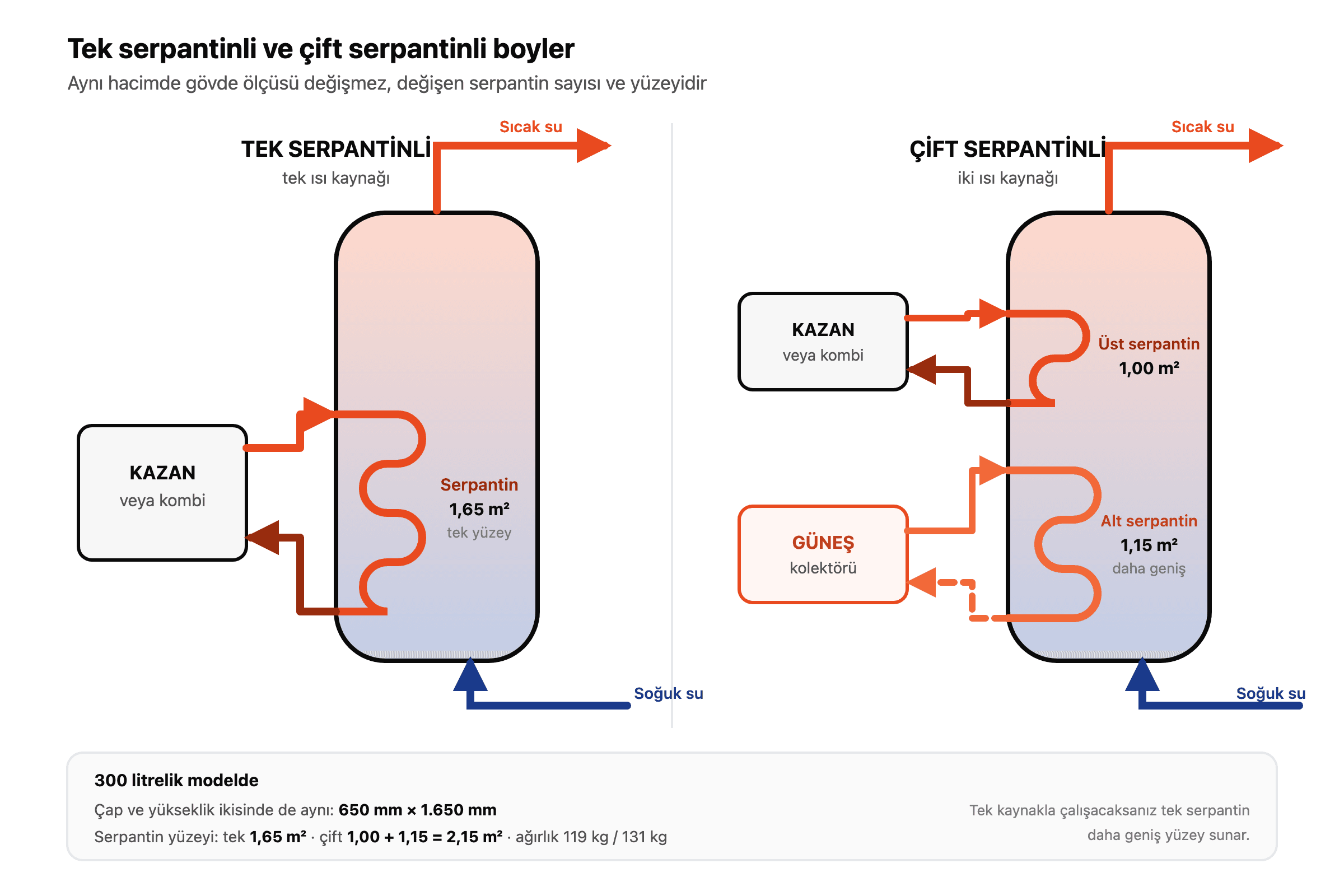
The coil inside a water heater is a heat exchanger too. Boiler water runs through the tube, the stored domestic water surrounds it, and heat passes through the tube wall. It is not a separate device but an exchanger built into the tank. See our what is a water heater article and the single coil water heater page.
Spiral and air-cooled types
In a spiral exchanger the fluids travel through coiled channels, which resists fouling. In an air-cooled exchanger the secondary fluid is air rather than water, and a fan moves the heat into the air stream.
| Type | How the surface is formed | Can it be opened and cleaned | Typical place |
|---|---|---|---|
| Plate, gasketed | Clamped plate pack | Yes, plate by plate | Central hot water, heat pumps |
| Plate, brazed | Permanently joined plates | No, chemical in place | Compact circuits |
| Shell-and-tube | Tube bundle inside a shell | Bundle can be withdrawn | High pressure, dirty fluids |
| Coil | Tube built into the tank | Yes on removable models | Water heaters |
The exchanger heats, the tank stores
A heat exchanger has no volume. It heats water on the way through and releases it; it stores no hot water inside. The practical consequence is this: the number of guests who can shower at seven in the morning in a hotel is set by the litres in the tank, not by the power of the exchanger. The exchanger heats, the tank stores. They are separate jobs, and in a central hot water system they are always installed together.
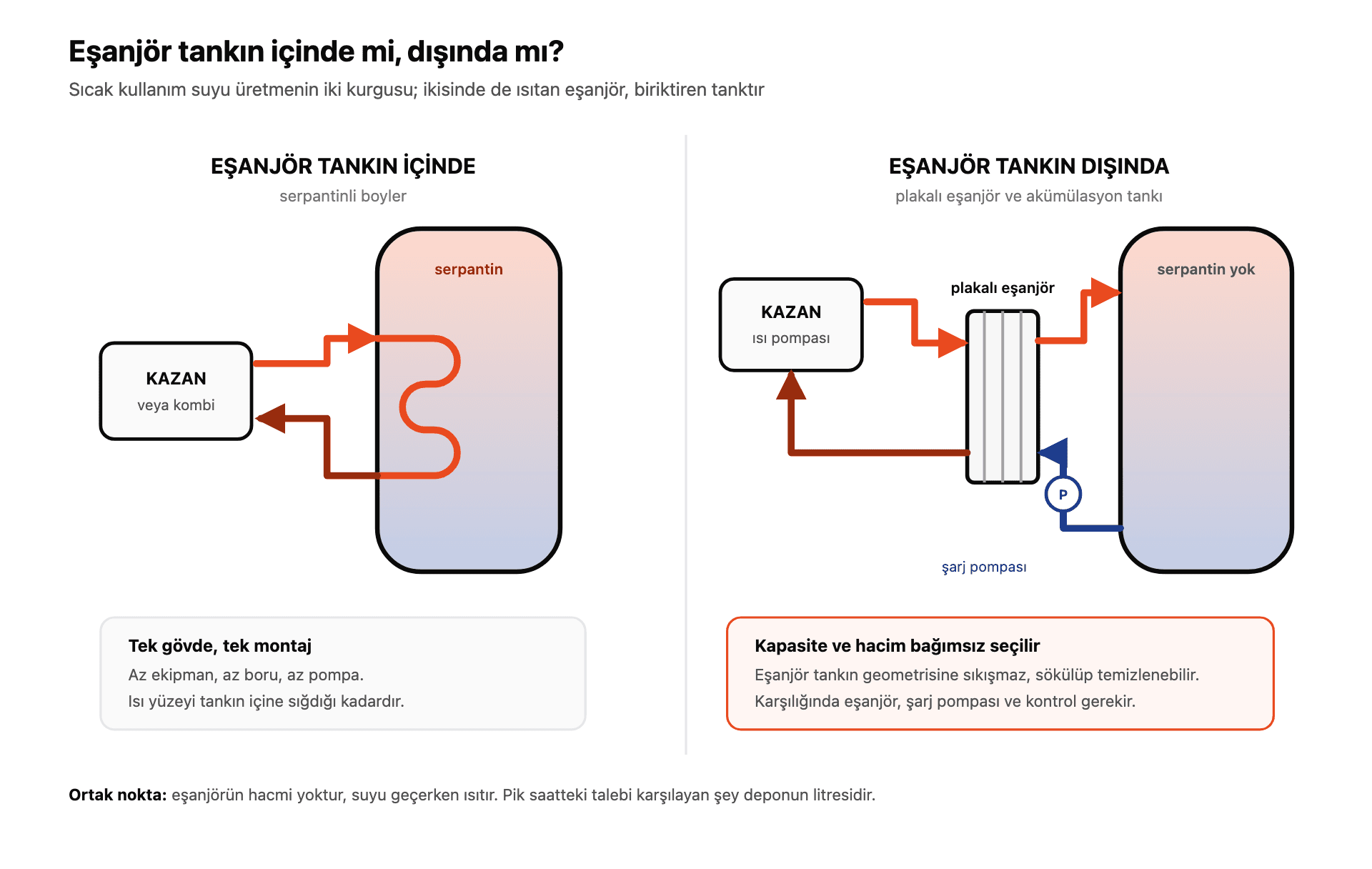
That leaves one design decision: does the exchanger sit inside the tank or outside it?
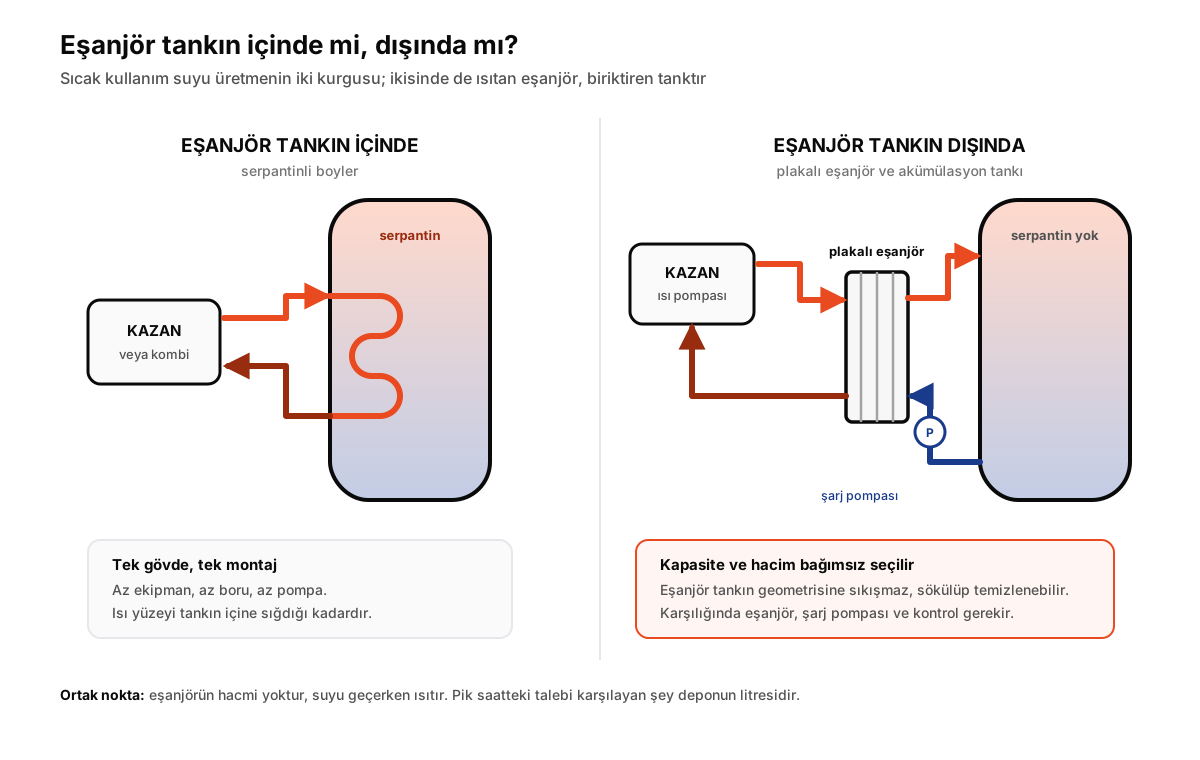 Two arrangements, with the exchanger inside and outside the tank: a coil water heater on the left, a plate exchanger with an accumulation tank on the right
Exchanger inside the tank: the coil water heater
The coil sits inside the tank, so a single body both heats and stores. That means less equipment, less pipework and fewer pumps. In exchange, the transfer surface is limited to what fits inside the shell, which ties coil area to tank volume. This is the common arrangement in homes, villas and small to mid-sized facilities. The Omega water heater range runs from 100 to 5,000 litres.
Exchanger outside the tank: plate exchanger and accumulation tank
An accumulation tank has no coil inside it. The water is heated outside the tank, in a plate exchanger, and pumped in. In principle the boiler flow and return connect to the primary side of the exchanger; cold water drawn from the bottom of the tank is pushed through the secondary side by a charging pump; the heated water is returned to the upper part of the tank. For the exact port sequence and installation rules see our accumulation tank connection diagram.
The real gain of this arrangement: transfer capacity and storage volume can be chosen independently of one another. The exchanger is not constrained by the tank's geometry, it can be enlarged, and it can be opened and cleaned. The cost is more equipment in the system.
In heat pump systems the distinction matters when picking the tank: if the stored water goes to the tap it is an accumulation tank; if the heating circuit needs buffer volume it is a buffer tank. The Omega tank range runs from 50 to 5,000 litres.
| Decision input | Exchanger inside | Exchanger outside |
|---|---|---|
| Equipment count | Low | Exchanger, charging pump, controls |
| Transfer surface depends on | Tank volume | The exchanger chosen |
| Exchanger maintenance | Tank must be drained | Removable in the circuit |
| Capacity and volume | Tied together | Chosen independently |
| Typical scale | Homes, small to mid facilities | Hotels, hospitals, dormitories |
Where heat exchangers are used
- Central domestic hot water (hotels, hospitals, dormitories, sports facilities)
- Circuit separation in district and geothermal heating
- Heat pump arrangements, separating source and usage circuits
- Pool water heating, keeping chlorinated water out of the heating pipework
- Solar collector circuits, keeping the antifreeze fluid away from domestic water
- Industrial process cooling, condensing and heat recovery
Materials and selection criteria
What sets the material is the chemistry of the fluid. Stainless steel is the common standard. Where the water carries chlorine, in pools and in seawater, titanium is chosen over stainless. Copper, which conducts heat well, is used for coils.
The questions to answer before selecting are these:
- Which two fluids are being kept apart?
- What is the hardness and chemistry of the water?
- Is the governing figure the instantaneous flow rate or the total volume drawn at peak?
- Does maintenance require a unit that can be opened?
- What is the working pressure of the circuit?
- How much room is available?
The third question gets skipped on most projects and turns expensive later. Before you can size the exchanger you need to know how many litres the tank will hold, because each one determines the other. For the litres, use our water heater calculator.
Cleaning and maintenance
Scale and sediment are what a heat exchanger has to fear. The layer that builds on the transfer surface behaves like insulation and cuts the transfer.
Fouling usually shows itself in three ways: the outlet temperature falls, the pressure drop across the unit rises, and the heat source runs longer to reach the same result.
A gasketed plate exchanger can be opened and its plates cleaned individually. A brazed unit cannot be opened and is cleaned in place by circulating a chemical. In a coil water heater the situation differs: scale collects both inside the tank and on the coil surface, and models with a removable copper coil make that work easier. For the tank side see our water heater cleaning article.
Quoting a fixed cleaning interval would be misleading. It depends on the hardness of the water and the operating temperature of the system, and it shortens noticeably in hard water regions.
Frequently asked questions
What does the word exchanger mean here?
A heat exchanger is any device that moves heat between two fluids without mixing them. In Turkish it appears as "eşanjör", from the French "échangeur", and as "ısı değiştirici", the literal translation.
Can a heat exchanger supply hot water on its own?
No, because it has no volume; it heats water passing through rather than storing it. Where consumption is steady it may be enough on its own. Where demand peaks in the morning and evening, it is always installed with a tank.
What is the difference between a water heater and a heat exchanger?
An exchanger only transfers heat. A water heater both transfers and stores, and the coil inside it is already an exchanger. See our what is a water heater article.
Is there an exchanger inside an accumulation tank?
No, an accumulation tank has no coil inside it. The water is heated outside the tank, usually in a plate exchanger, and pumped in. That is why an accumulation tank is always designed together with a heating arrangement.
Plate exchanger or coil water heater?
The decision comes down to scale and maintenance access. Where a single body and minimal equipment are wanted, the coil water heater. As peak demand sharpens and the exchanger needs to be sized independently, opened and cleaned, the plate exchanger with an accumulation tank moves ahead.
How often should a heat exchanger be cleaned?
There is no fixed interval that suits everyone; water hardness and operating temperature decide it. The indicators to watch are a falling outlet temperature and a rising pressure drop.
The exchanger side of a project is engineering work: once the fluids, flow rates and pressures are settled, the type and the surface follow. The tank side is a decision about litres, and it is often what actually determines whether the system feels comfortable in use. Size the litres with our water heater calculator, and get in touch for an arrangement suited to your facility.