
Short answer
The difference between a single and a double coil water heater is the number of heat sources the tank can take. A single coil heater has one heat exchanger and connects to one source: a boiler, a combi or a solar collector. A double coil heater has two separate coils; the lower one usually connects to the solar collector and the upper one to the boiler or combi, so two sources heat the same tank in turn. The decision rule is simple: if you have a second heat source, or plan one in the near future, choose double coil; if not, single coil is the right call. The point people miss is that each coil in a double unit is smaller than the single coil of an equivalent tank, so if you will only ever run one source, the single coil model transfers heat faster. Below we compare dimensions, coil surface and weight using Omega catalogue figures, explain why the lower coil is larger than the upper one, and set out which installation calls for which.
What is a coil, and why would there be two?
A coil is a bent tube placed inside the tank that works as a heat exchanger. Hot circuit water from the boiler or solar collector flows through the tube, transfers its heat through the tube wall to the domestic water in the tank, and returns to the source cooled. The two circuits never mix at any point; for the fundamentals see what is a water heater.
The second coil exists because of heat source count. Solar energy arrives unevenly through the day: it falls short morning and evening and produces almost nothing under cloud. Left on its own it cannot deliver uninterrupted hot water. A second coil closes that gap by bringing a boiler or combi into the same tank. When solar is sufficient the boiler never fires; when it falls short, the boiler brings the water up to target.
The difference between single and double coil
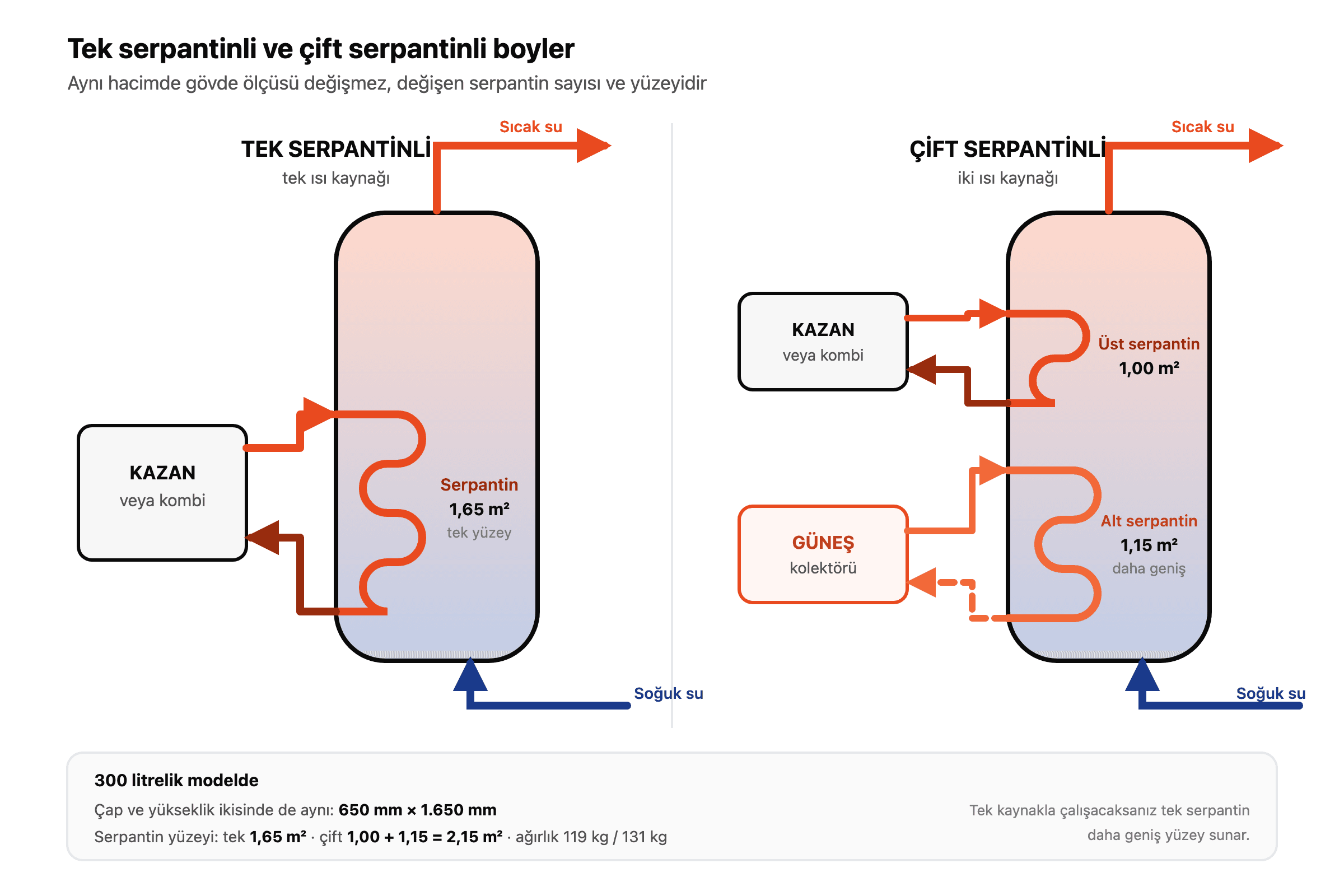
The most common misconception is that a double coil unit is a bigger tank. Omega catalogue figures show it is not: at the same volume both models have identical diameter and height.
| Value | 300 L single | 300 L double | 500 L single | 500 L double | 1,000 L single | 1,000 L double |
|---|---|---|---|---|---|---|
| Diameter (mm) | 650 | 650 | 750 | 750 | 950 | 950 |
| Height (mm) | 1,650 | 1,650 | 1,650 | 1,650 | 2,100 | 2,100 |
| Coil surface (m²) | 1.65 | 1.00 + 1.15 | 2.40 | 1.25 + 1.85 | 3.50 | 2.00 + 2.83 |
| Total surface (m²) | 1.65 | 2.15 | 2.40 | 3.10 | 3.50 | 4.83 |
| Dry weight (kg) | 119 | 131 | 160 | 175 | 271 | 304 |
Three conclusions follow:
- Floor space does not change. Moving to a double coil unit needs no extra room in the plant space; the second coil goes inside the same shell.
- Weight rises by roughly 10 percent. That is 12 kg at 300 litres and 33 kg at 1,000 litres, which is not a meaningful constraint for handling or floor loading.
- Total heating surface rises, but each individual coil shrinks. In the 300 litre model the single coil is 1.65 m² while the upper coil of the double is only 1.00 m². That distinction is the crux of the choice, and we unpack it below.
Capacity ranges also differ: the single coil water heater starts at 100 litres, the double coil water heater at 160 litres. There is no 100 litre double coil option for small dwellings.
Why is the lower coil larger than the upper one?
Look at any double coil heater and the lower coil is always wider than the upper. In the 300 litre model the lower is 1.15 m² against 1.00 m² for the upper; at 1,000 litres it is 2.83 m² against 2.00 m². This is not a manufacturing preference, it follows from physics.
Heat transfer is proportional to surface area and temperature difference. Boiler water arrives at around 70 to 80 °C, while the heat transfer fluid from a solar collector usually arrives cooler. When the temperature difference narrows, more surface is needed to move the same heat. That is why the coil serving solar is built wider.
Position follows the same logic. Cold water enters at the bottom and heated water gathers at the top. If the solar circuit works in the coldest zone of the tank, the temperature difference is at its greatest and the collector operates at its most efficient point. The boiler then sits higher, in the zone where hot water is drawn, and brings it to target temperature. Port layout on the tank is covered in our water heater connection diagram.
 Cutaway comparison of a single coil and a double coil water heater: coil count, position and the heat sources they connect to
Which one should you choose?
The decision comes down to one question: how many heat sources will connect to the tank?
A single coil water heater is right when:
- There is one heat source: a combi, a boiler, or solar alone.
- There is no plan for a second source. If solar is not on the agenda, paying for a second coil returns nothing.
- Fast heat transfer matters. At the same volume the single coil is markedly wider than the upper coil of a double unit, so a single-source system heats the tank sooner.
- You need something in the 100 to 160 litre band, where double coil units are not made.
A double coil water heater is right when:
- A solar collector will run alongside a boiler or combi. This is the most common arrangement.
- Solar is deferred but planned. Buying a double coil tank up front costs less than replacing the tank later.
- A heat pump will run together with a second source.
- The site is a hotel, dormitory or hospital where hot water cannot be interrupted. Two sources back each other up; if one fails, hot water continues.
How many litres you need is a separate calculation driven by fixture count; our water heater calculator will size it in minutes. To weigh type and capacity together, our how to choose a water heater guide covers the capacity side in detail.
Is the price difference worth it?
The double coil model costs more at the same volume. On July 2026 retail references the single coil 100 litre starts around 15,000 TL while the double coil 160 litre starts around 21,000 TL. The gap comes from the material and labour of the second coil.
You only recover that gap if the second heat source is genuinely used. On a system with a solar collector, fuel savings close it over time; we set out efficiency and payback for solar systems in our solar water heater article. If the second source is never connected, the upper coil sits idle and you have both paid more and ended up with a smaller heating surface than the single coil model would have given you.
One note on retrofitting: a second coil cannot be added to an existing single coil tank. If solar is a realistic prospect, buying double coil from the start is markedly cheaper than replacing the whole tank two years later.
Frequently asked questions
What is the difference between single and double coil water heaters?
The difference is the number of heat sources the tank can take. A single coil unit has one heat exchanger and connects to one source. A double coil unit has two separate coils; the lower usually serves a solar collector and the upper a boiler or combi. At the same volume both have identical diameter and height, with the double roughly 10 percent heavier.
How does a double coil water heater work?
The solar collector on the lower coil pre-heats the water in the coldest zone of the tank. When solar cannot reach the target temperature, the boiler or combi on the upper coil takes over and finishes the job. If solar is sufficient the upper circuit never runs. Neither heat source water mixes with the other, nor with the domestic water.
Is a double coil water heater bigger?
No. On Omega catalogue figures the diameter and height are identical at the same volume; at 300 litres both models are 650 mm across and 1,650 mm tall. Only dry weight rises, from 119 kg to 131 kg at 300 litres. It needs no extra floor space.
I only have one heat source, can I still buy double coil?
You can, but with two drawbacks. You pay more, and you work with a smaller heating surface than the single coil model would give: at 300 litres the single coil is 1.65 m² while the upper coil of the double is 1.00 m². If a second source is not on your near-term plan, single coil is the better choice.
Can a second coil be added to my existing water heater?
No. The coil is placed inside the shell while the tank is built and goes through the enamel coating process with it. It cannot be added afterwards. For that reason, where solar is a realistic prospect, the tank should be specified as double coil from the outset.
Which coil connects to solar on a double coil unit?
The lower coil goes to the solar collector and the upper to the boiler or combi. The reason is both stratification and heat transfer: the coldest zone of the tank is at the bottom, so the collector working there operates at the greatest temperature difference, which is its most efficient point. Confirm the exact orientation against the port markings on the product label.
Choosing between single and double coil is not a question of tank size or budget, it is a question of how many heat sources will connect to the system. If you will run one source, the single coil is both cheaper and gives a wider heating surface; if a solar collector is in service or on the plan, double coil is the only right option. You can review the ranges on our single coil and double coil pages, and size the litres you need with our water heater calculator. To settle the right type for your project, get in touch.