
Short answer
A water heater safety valve discharges water once tank pressure passes its set point, and it mounts on the cold water inlet line with no shut-off valve left between the valve and the tank. Its set pressure sits between two limits: below the tank's maximum permissible working pressure (10 bar on Omega tanks) and clearly above the system's cold operating pressure. Continuous weeping is usually not a faulty valve at all. It means nothing is absorbing the thermal expansion of the heated water: the check valve on the cold line turns the installation into a closed volume, water expands as it heats, and the pressure loads the only outlet it has. Below we cover which standard governs valve selection, the correct order of components on the line, how expansion vessel pre-charge is set, and how to tell the failure modes apart on site.
What the safety valve does in a water heater
Water expands as it heats. One litre at 10 °C occupies roughly 1.7 percent more volume at 60 °C. In a 300 litre tank that is about 5 litres of extra volume on every heating cycle. That volume has to go somewhere. If it cannot flow back into the mains, it turns into pressure.
The safety valve is the controlled outlet for that pressure. A spring holds the disc closed; when line pressure exceeds the set value the disc lifts and part of the water goes to the drain. Once pressure drops, the disc reseats. This is the only component protecting the shell, the coil and the connection ports from overpressure.
The valve does not work alone. Safety on a water heater installation is split across three parts, and none of them substitutes for another:
| Component | Function | Position on the line |
|---|---|---|
| Check valve | Stops heated, expanding water flowing back into the mains, turning the installation into a closed volume | Cold inlet line, mains side |
| Expansion vessel | Takes the extra volume into the air cushion behind its diaphragm and damps the pressure rise | Between the check valve and the tank |
| Safety valve | Discharges water once pressure exceeds the set point; the last line of defence | Between the expansion vessel and the tank, as close to the tank as possible |
The logic of that order is simple: the check valve creates the problem, the expansion vessel solves it, and the safety valve steps in when the solution fails. Port layout on the tank itself is covered in our water heater connection diagram.
What pressure should a water heater safety valve be rated for?
There is no single answer, but two hard limits narrow the choice.
The upper limit is the tank's working pressure. The valve's set pressure can never exceed the maximum permissible working pressure of the tank. Omega water heaters and accumulation tanks are built for 10 bar working and 13 bar test pressure, so 10 bar is the absolute ceiling and in practice the valve is chosen well below it.
The lower limit is the system's operating pressure. Set the valve too close to normal working pressure and it will lift during ordinary use. Mains pressure in Türkiye typically runs between 2 and 6 bar depending on district and building height. Fitting a 6 bar valve in a building with 5 bar mains means the valve works on every heating cycle. When the margin is too small, the fix is a pressure reducing valve at the inlet, not a larger relief valve.
The product class also drives the selection. Three European standards define these components:
| Standard | Component | Pressure range | Application |
|---|---|---|---|
| EN 1489 | Pressure safety valve | 1 - 10 bar | Cold water supply of storage water heaters, max. 95 °C |
| EN 1487 | Hydraulic safety group (valve, check valve and discharge in one body) | 1 - 7 bar | Cold water supply of storage water heaters, max. 95 °C |
| EN 1490 | Combined temperature and pressure relief valve | 1 - 10 bar | Storage water heaters, holds temperature below 100 °C |
The combined valve under EN 1490 exists to prevent water flashing to steam when the other temperature controls fail. In the standard's own wording it is not intended to act as an expansion valve under normal conditions, which means fitting one does not remove the need for an expansion vessel.
Where does the safety valve mount?
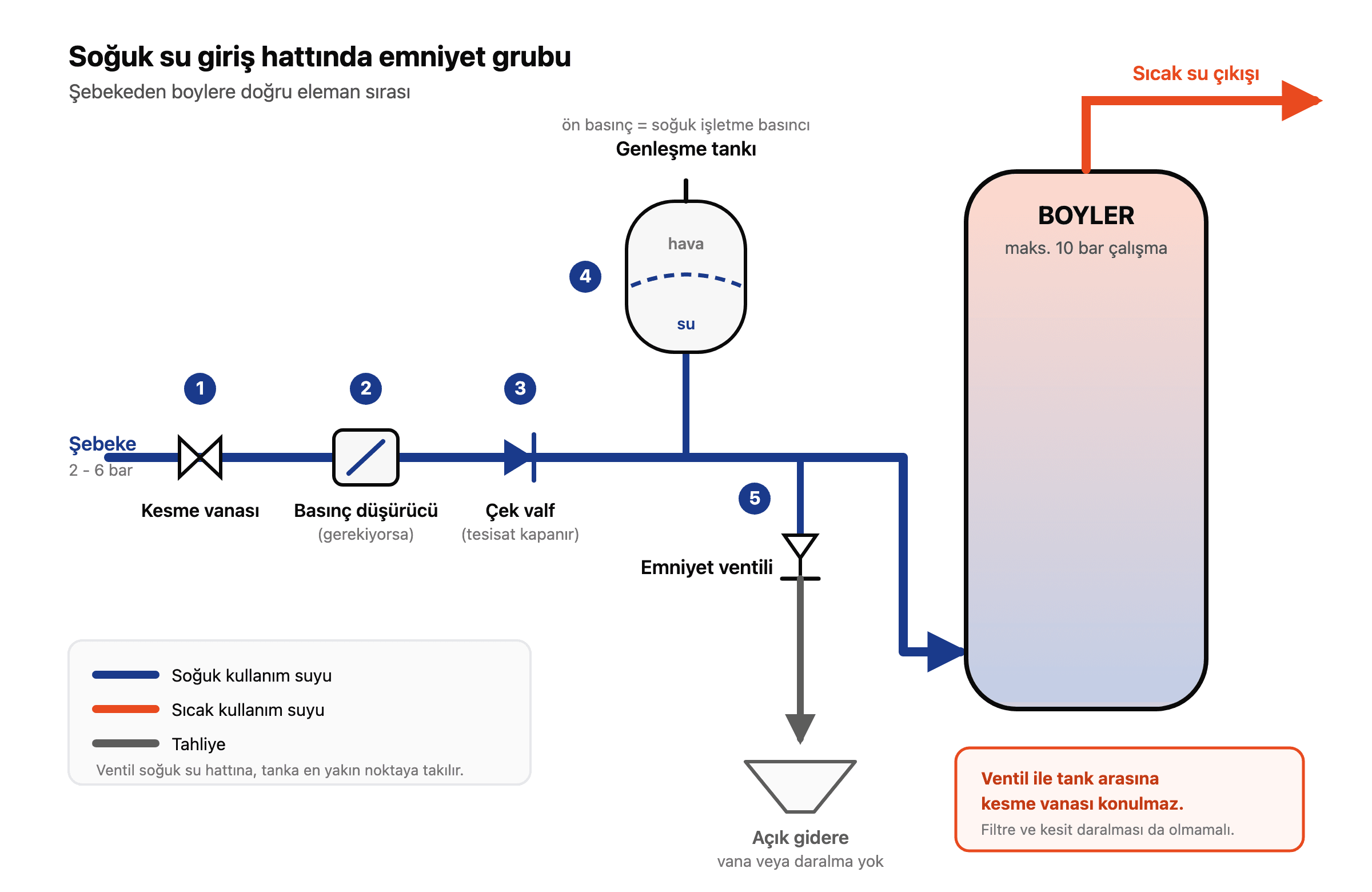
The safety valve mounts on the cold water inlet line, as close to the tank as the pipework allows. All three standards define these components on the cold water supply; a valve fitted to the hot outlet cannot protect the tank while the hot water valve is closed.
 Order of components in the safety group on a water heater cold inlet line: isolating valve, check valve, expansion vessel and safety valve
The order on the line runs as follows:
- An isolating valve goes on the mains side so the line can be separated for maintenance.
- A pressure reducing valve is added where needed. When mains pressure sits close to the valve set point this component is not optional.
- The check valve is fitted. It stops expanding water returning to the mains, and from this point on the installation is a closed volume.
- The expansion vessel is connected between the check valve and the tank.
- The safety valve is mounted closest to the tank. No isolating valve, strainer or reduction in bore may sit between the valve and the tank.
- The discharge is routed to an open drain where it can be seen. The pipe must not be reduced in bore and must never carry a valve.
Leaving the discharge visible is not an arbitrary preference. EN 1487 defines one function of the safety group as preventing the discharged water from coming into contact with the water inside the heater. Piping the discharge directly into a line, or capping its end, breaks that protection and also makes it impossible to see whether the valve is working.
Without an expansion vessel the valve is bound to weep
The most common site error is fitting a check valve and no expansion vessel. In that arrangement the installation becomes a closed volume and the only outlet for the expanding water is the safety valve. The valve is not faulty; it is doing exactly the job it was designed for.
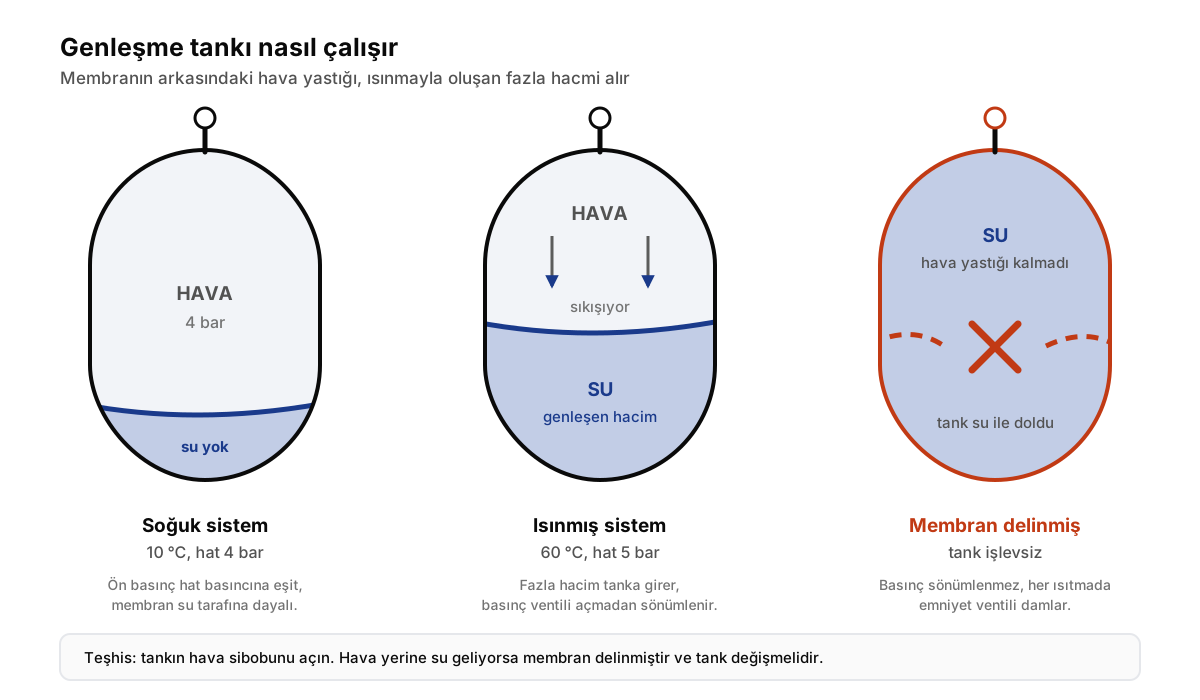 How an expansion vessel works: diaphragm position and air cushion compression in cold, heated and ruptured states
An expansion vessel holds two chambers separated by a flexible diaphragm: water on one side, pre-pressurised air on the other. As the water expands it pushes the diaphragm, the air cushion compresses and the pressure rise is damped.
The critical figure here is the pre-charge, and it is frequently confused on the potable side. The 0.9 to 1.5 bar range quoted for combi expansion vessels belongs to closed circuit heating systems. A water heater is a domestic hot water installation running at mains pressure; its pre-charge is set equal to, or just below, the system's cold operating pressure. In a building with 4 bar mains the vessel pre-charge should also be around 4 bar. The vessel must also be a potable type built with a diaphragm approved for drinking water; a heating circuit vessel is not suitable.
Vessel size depends on the gap between pre-charge and set pressure. As that gap narrows, the same expansion volume needs a larger vessel. Taking the roughly 5 litres generated by a 300 litre tank going from 10 °C to 60 °C, in a system with 4 bar pre-charge and a 6 bar relief setting the acceptance ratio calculated on absolute pressures is about 29 percent, which corresponds to a vessel of roughly 17 litres. Sizing starts from the tank itself; you can work out the litres you need with our water heater calculator.
Five reasons a safety valve weeps
The fastest route to the cause is to note when the water appears. Timing alone separates most of these failures.
| When does it weep | Most likely cause | How to check |
|---|---|---|
| Starts as the tank heats, stops as it cools | No expansion vessel, undersized vessel, or a ruptured diaphragm | Depress the vessel's air valve; water instead of air means the diaphragm has failed |
| Weeps continuously, even on a cold system | The valve is not reseating; scale or debris on the seat, or a tired spring or seal | Lift the valve open once and release it; if weeping continues the valve needs replacing |
| Weeps overnight with the heater idle | Mains pressure sits too close to the valve set point | Fit a gauge at the inlet and read night-time pressure; add a pressure reducing valve if needed |
| Very hot water or steam at the discharge | Thermostat failure, tank overheating | Shut off the heat source immediately and have the thermostat and high-limit checked |
| Started right after a new installation | Wrong set pressure, or a valve fitted between the relief valve and the tank | Check the set pressure on the valve label and the order of components on the line |
The first two rows cover most cases. When an expansion vessel's diaphragm ruptures the vessel fills with water, no air cushion remains, and it behaves as though it were not there at all. From the outside the system has a vessel; functionally it does not. Water at the air valve is the definitive sign.
Scale on the seat is common in hard water areas and usually signals deposits elsewhere in the tank too. To assess sediment and anode condition together, see how to clean a water heater.
Capping a weeping valve, plugging it or restricting the discharge is never a fix. The valve is the single point where pressure leaves the tank without damaging it; closing it does not remove the pressure, it only hides it.
Frequently asked questions
How is the safety valve set pressure determined?
The set pressure is chosen below the tank's maximum permissible working pressure and clearly above the system's cold operating pressure. Omega tanks work at 10 bar, so that is the ceiling; in a building with 4 bar mains a 6 bar valve is a typical choice. Where mains pressure sits close to the valve rating, fit a pressure reducing valve at the inlet.
Can the safety valve be fitted to the hot water outlet?
On the cold water inlet line, as close to the tank as possible. EN 1487, EN 1489 and EN 1490 all define these components on the cold water supply of storage water heaters. No isolating valve, strainer or reduction in bore may sit between the valve and the tank, and the discharge must run to an open drain.
What should I do if the safety valve is dripping?
First establish when it drips. If it only drips while the tank heats, the problem is most likely the expansion vessel rather than the valve: depress the vessel's air valve, and if water comes out the diaphragm has ruptured. If it drips continuously even on a cold system, the valve seat has scaled or the spring has tired and the valve should be replaced.
How can I tell if a safety valve has failed?
Failure runs in two directions. A valve that drips while the system is cold and pressure is normal is not reseating. The reverse case is not proof of health either: a valve can seize shut with scale and never discharge. On models with a manual lever, lifting it briefly and releasing it is the practical way to confirm the valve moves and reseats.
Is an expansion vessel mandatory on a water heater?
It is required on any installation with a check valve or backflow preventer on the cold line. The check valve turns the system into a closed volume and stops the extra volume returning to the mains. Without a vessel the only outlet for that volume is the safety valve, and the result is weeping on every heating cycle plus gradual damage to the valve seat.
What should the expansion vessel pre-charge be?
On the potable side the pre-charge is set equal to, or just below, the system's cold operating pressure: 4 bar mains means roughly 4 bar pre-charge. The 0.9 to 1.5 bar range quoted for combi expansion vessels belongs to closed circuit heating systems and does not apply to a water heater's potable line. The vessel must also carry a diaphragm approved for drinking water.
What is the difference between a safety valve and a check valve?
A check valve controls direction, a safety valve controls pressure. The check valve stops heated, expanding water flowing back into the mains and turns the installation into a closed volume. The safety valve discharges water once pressure exceeds its set point. Neither replaces the other; in fact the closed volume created by the check valve is precisely why the expansion vessel and the safety valve become necessary.
A safety valve looks like a single fitting, but it only works when four components on the line are selected together: the pressure reducing valve, the check valve, the expansion vessel and the valve itself. When those four are mismatched the symptom is always the same, a weeping valve. For port layout on the tank see the water heater connection diagram, and for safety components on accumulation tank installations see the accumulation tank connection diagram. You can browse the range on our water heaters page or get in touch for help specifying the safety group for your project.